
From Robot Intelligence to Human Confidence
Why the Future of Robotics Depends on More Than Smarter Machines
To date, robotics has largely solved the challenge of machine intelligence. The next challenge is building human confidence in working alongside robots. Custom Robotics of La Jolla's Dave Skillin believes The Empathy Layer for Robotics™ is the missing bridge between what robots know and what people need to work confidently alongside them.
David Skillin · August 20, 2026
The robotics industry has spent decades pursuing one objective: making robots more intelligent. Artificial intelligence has transformed what autonomous systems (opens in a new tab) can accomplish.
Today's robots can:
- Navigate complex environments
- Recognize objects
- Optimize routes
- Avoid obstacles
- Learn from experience
- Make sophisticated decisions without human intervention
By nearly every technical measure, robots have never been smarter—yet one question remains.
If robots have become so intelligent, why hasn't adoption in warehouses, factories, hospitals, airports, hotels, public spaces, and even homes accelerated at the same pace?
The adoption of robotics will not be determined solely by how intelligent or autonomous machines become. It will be determined by how confidently people can work alongside them. Trust is the key.
Intelligence Solves Machine Problems
Artificial intelligence has enabled remarkable advances across the robotics industry, allowing modern machines to process enormous amounts of information every second. Thus, robots essentially "know" their operational status and next move at all times. But people—especially those working side-by-side with robots—rarely have access to the same information robots use to make decisions.
The result is a growing communication gap between machine ability and human understanding.
Confidence Is a Human Decision
Most people evaluate technology very differently from engineers. While engineers tend to ask, "Does it work?" "Is it accurate?" "Is it reliable?" or "Is it efficient?", people working near a robot might ask a different set of questions.
- Is it safe?
- What is it doing?
- What information is it collecting?
- Where is it storing data?
- What happens next?
- Does it know I'm here?
- Can I trust it?
These questions are emotional as much as technical. Confidence is earned through repeated, intuitive demonstrations of status, intent, and operations—signals that help humans instantly understand what the robot is doing and why.
Intelligence Without Confidence Slows Adoption
Imagine two autonomous robots with identical intelligence. Both navigate flawlessly and meet every engineering requirement. Yet one consistently communicates its intent, operational status, and awareness to nearby workers, while the other remains silent.
Technically, they perform the same. Operationally, they create very different human experiences.
Workers naturally feel more at ease around systems they can interpret. Managers are more likely to deploy technology they believe employees will accept. Safety professionals favor systems that reduce uncertainty. The difference in adoption and preference isn't intelligence—it's confidence and trust.
Human Confidence Is Built Through Communication
Human beings rely on communication to bolster their confidence every day.
Drivers depend on:
- Brake lights
- Turn signals
- Stop signs
- Traffic lights
- Highway lines
Pilots depend on:
- Warning systems
- Instrument displays
- Standardized alerts
- Airport lights
- Radar
Healthcare professionals depend on:
- Patient monitors
- Alarm systems
- Vital signs
None of these systems or approaches make the underlying technology more intelligent. They simply make it more understandable to humans.
Robotics now faces the same challenge. As autonomous systems move into shared human spaces, people need immediate understanding—not additional technical complexity.
Why Confidence Matters
Businesses often measure robotics success through:
- Productivity
- Throughput
- Accuracy
- Return on investment
- Downtime
- Labor savings
While these metrics are important, another may become equally valuable: human confidence.
Confidence influences:
- Workforce acceptance
- Deployment speed
- Training requirements
- Operational efficiency
- Safety perception
- Long-term scalability
When confidence is high, organizations move faster and adapt to change more quickly. When confidence is low, the adoption of even successful technology encounters resistance.
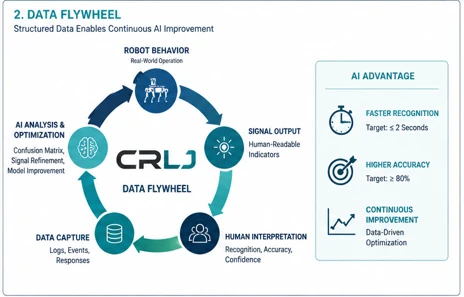
The Empathy Layer for Robotics™
"Custom Robotics believes the robotics industry is missing a critical category," explains Skillin. "We call it The Empathy Layer for Robotics™ which bridges the communication gap between machines and humans being able to confidently work side-by-side with them."
The purpose of the empathy layer is to translate robotic behavior into intuitive, human-readable communication. Rather than asking people to interpret complex autonomous systems, robots should be able to communicate naturally through visible, standardized signals.
People should be able to instantly understand:
- What the robot is doing
- What it plans to do next
- Whether it has detected them
- Whether it is operating normally
- What data it's accessing and what it's doing with it
- Whether it is safe to approach
Understanding robot status and intent creates confidence, and confidence builds trust, which accelerates adoption.
Integrating Security, Transparency, and Independent Validation
As robots become more autonomous, people need more than clear movement‑intent communication. They also need trust in how robots handle information, manage data flows, and operate within shared environments.
This trust consists of three critical elements:
Security & Data Handling
People want to know what a robot sees, collects, accesses, and transmits—and that its data practices are responsible and secure.
Clear Movement & Intent Communication
Robots must communicate their next action and operational state in ways humans instantly understand.
Independent Third‑Party Validation
Manufacturers cannot be the sole authority on trust. Neutral, third-party experts must confirm how robots behave, communicate, and manage sensitive information.
Together, these elements create evidence‑based trust—the foundation of confident human‑robot collaboration—and form the basis of Custom Robotics' developing CRLJ Assured™ framework.
CRLJ Assured™
CRLJ Assured™, currently in development, is intended to independently review and validate a robotics system's behavior, data practices, and status‑ and movement‑intent communication capabilities—with the goal of giving people confidence they can work safely and comfortably alongside them.
Why AI Alone Isn't Enough
With the promise of continuous advances in artificial intelligence, robots will become:
- Faster
- More autonomous
- More adaptive
- More capable
But every increase in machine intelligence also increases the importance of human interaction and understanding. The smarter robots become, the less people will be able to easily predict their behavior.
Without reliable and effective communication, this greater intelligence can create greater uncertainty. The solution is not less intelligence—it's better communication.
From Intelligence to Confidence
The next evolution of robotics is not simply building machines that think better, it's building machines that communicate better. This shift represents the difference between technical success and operational success, between engineering achievement and workforce acceptance, between innovation and widespread adoption.
"Artificial intelligence tells the robot what to do. Human understanding tells people it's safe to work alongside it," says Skillin. "That distinction may become one of the defining characteristics of next-generation robotics."
Looking Ahead: How Custom Robotics Sees It
The robotics industry (opens in a new tab) has spent decades solving the intelligence problem—building machines that can perceive, decide, and act with increasing precision. But the next decade will be defined by a different challenge: solving the confidence problem. As robots move closer to people and into everyday workflows—even in homes—the question shifts from "how smart the machine is" to "how comfortable humans feel working/living alongside it."
Organizations that recognize this shift early will build stronger, more natural relationships between people and machines. They'll deploy new systems faster because employees won't hesitate to use them. They'll scale more quickly because the workforce will trust the technology rather than resist it. For them, confidence will become a catalyst—accelerating adoption, acceptance, and operational success.
Frequently Asked Questions
1. If robots are so intelligent, why is adoption still slow?
Because people often don't understand what robots are doing. Intelligence improves machine performance, but uncertainty and lack of confidence slow human acceptance.
2. What does "human confidence" mean in robotics?
It's the trust people feel when they can easily interpret a robot's behavior—its status, intent, and awareness.
3. Why is communication essential for autonomous robots?
Without clear signals or cues, humans must guess what a robot is doing. Communication removes that guesswork and builds confidence.
4. What is The Empathy Layer for Robotics™?
It's a communication layer that translates robotic behavior into simple, human-readable signals so people instantly understand what the robot is doing and why.
5. Why isn't artificial intelligence alone enough?
Smarter robots can become harder for humans to predict. Without better communication, increased intelligence can create more uncertainty—not less.
6. What is CRLJ Assured™ and how does it improve human‑robot interaction?
CRLJ Assured™ is Custom Robotics' developing independent assurance framework, intended to verify that a robot handles data responsibly, communicates intent clearly, and operates safely. It is designed to offer third‑party confirmation that the system is understandable and predictable.
Time to Make Your Robots Human‑Ready
If you're looking to bridge the divide between robot autonomy and human acceptance, contact Custom Robotics of La Jolla at info@customrobotics.io to arrange a free, no‑strings‑attached consultation.
About David Skillin
David Skillin is Founder and CEO of Custom Robotics of La Jolla and creator of The Empathy Layer for Robotics™ framework. His work focuses on improving safety, clarity, trust, and adoption in shared human-robot environments.
About Custom Robotics of La Jolla
Custom Robotics of La Jolla (CRLJ) is defining The Empathy Layer for Robotics™—helping humans understand, trust, and safely interact with autonomous systems.