
The Adoption Gap in Automation
Why the Greatest Challenge Facing Robotics Isn't Technology—It's Human Acceptance
Custom Robotics of La Jolla is redefining how humans understand and trust autonomous systems by making robotic behavior visible, intuitive, and human‑ready—because technology only succeeds when people feel confident working alongside it.
David Skillin · June 10, 2026
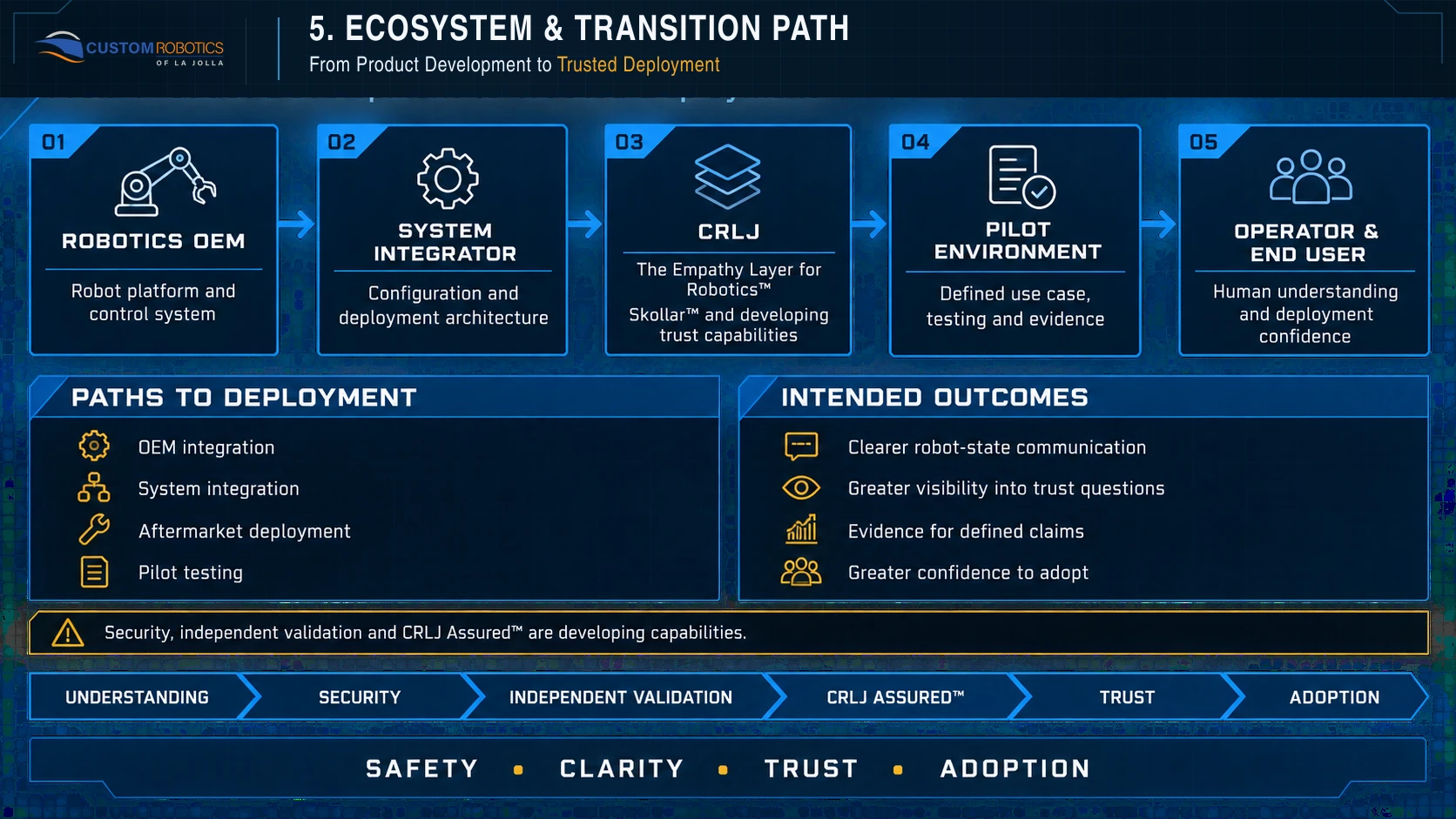
The automation industry has never been stronger. Artificial intelligence continues to advance at an unprecedented pace. Robotics systems are becoming more capable, more autonomous, and more accessible. Warehouses, factories, hospitals, airports, and logistics centers are increasingly adopting automation to address labor shortages, improve productivity, and enhance operational efficiency.
On paper, the future looks inevitable.
Yet many robotics deployments still struggle to move beyond pilot programs.
- The technology works.
- The business case is sound.
- The return on investment is compelling.
- But adoption remains slower than expected.
Why?
There is a difference between implementing automation and achieving adoption.
Custom Robotics of La Jolla (CRLJ) calls this challenge the Adoption Gap—the space between what robots are capable of doing and what humans are comfortable accepting.
While the robotics industry has spent decades focusing on machine intelligence, far less attention has been given to the human side of automation—namely, how people perceive, interpret, and safely respond to robotic behavior. This may be the biggest obstacle standing between today's robotics capabilities and tomorrow's widespread adoption.
The Automation Paradox
Organizations often assume that once a robotics solution demonstrates measurable value, adoption naturally follows. However, reality is far more complicated.
Many companies discover that even successful deployments encounter resistance.
- Workers hesitate.
- Managers become cautious.
- Safety teams raise concerns.
- Stakeholders ask difficult questions.
The technology itself may perform flawlessly, yet implementation is slow. We call this phenomenon the "Automation Paradox" wherein the more autonomous systems (opens in a new tab) become, the more important human acceptance becomes.
As robots move into shared human environments, adoption becomes less about technology and more about trust.
The Human Side of Automation
When robotics professionals discuss deployment challenges, the conversation often focuses on:
- Hardware
- Software
- Integration
- Infrastructure
- AI performance
- System reliability
These are all important factors, but there is another variable that receives far less attention: human behavior.
People naturally evaluate new technologies through an emotional lens. They ask questions such as:
- Is this safe?
- Can I trust it?
- Will it replace me?
- Do I understand what it's doing?
- What happens if something goes wrong?
These questions are rarely addressed by technical specifications. Instead, they are answered through experience, communication, and understanding.
"The robotics industry often treats adoption as a technical problem while, in reality, adoption is a human problem," explains CRLJ Founder and CEO David Skillin (opens in a new tab). "People don't resist robots because robots exist. They resist uncertainty."
That uncertainty represents one of the largest barriers to automation today.
Understanding the Adoption Gap
The Adoption Gap exists when a robotics system is technically successful but human acceptance lags behind. The gap is often fueled by:
Ambiguity
- Workers cannot easily determine what a robot is doing or what it plans to do next.
Lack of Visibility
- Critical information remains inside the machine instead of being communicated externally.
Limited Familiarity
- People trust systems they understand, and new technologies often lack that familiarity.
Communication Challenges
- Robots frequently communicate with software systems more effectively than they communicate with humans.
Perceived Risk
- Even technically safe systems can create discomfort when behavior is unclear. This creates friction and friction slows adoption.
Why Technical Success Isn't Enough
A robot can achieve exceptional performance metrics and still struggle to gain acceptance.
Organizations often measure:
- Throughput
- Accuracy
- Productivity
- Downtime
- Efficiency
What they rarely measure is human confidence, which just might have a greater impact on long-term success than many traditional metrics.
Confidence influences:
- Workforce acceptance
- Deployment speed
- Operational trust
- Safety perception
- Organizational buy-in
Without confidence, adoption becomes difficult. With confidence, organizations can scale much more effectively.
Lessons from Other Technologies
History offers numerous examples of technologies that succeeded because they became easier for humans to understand.
- Personal computers existed before graphical user interfaces.
- The internet existed before web browsers.
- Automobiles existed before modern safety and communication standards.
Yet each of these technologies experienced accelerated adoption when human usability improved.
Robotics is approaching a similar inflection point. The challenge is no longer whether robots can perform the work. The challenge is whether humans feel comfortable working alongside them.
Why Communication Matters
Communication is one of the most effective ways to reduce uncertainty. Humans constantly rely on signals to interpret their environment.
For example, drivers use:
- Turn signals
- Brake lights
- Traffic lights
- Road signs
Healthcare professionals rely on:
- Vital signs
- Alerts
- Visual indicators
Pilots rely on:
- Warning systems
- Instrumentation
- Standardized communication protocols
These systems exist because people need situational awareness. Robotics should be no different.
As robots become more common in shared environments, communication becomes increasingly important. People need to know:
- What the robot is doing
- What it plans to do next
- Whether it has detected them
- Whether it is operating normally
Without this understanding, uncertainty remains.
The Empathy Layer for Robotics™
At CRLJ, we believe the robotics industry is missing a critical category: The Empathy Layer for Robotics™. This layer serves as the bridge between machine intelligence and human understanding. Its purpose is to translate robotic behavior into intuitive, human-readable communication.
This includes communicating:
- Status
- Intent
- Direction
- Safety conditions
- Operational awareness
The goal is not to make robots more intelligent. The goal is to make intelligence more visible because understanding drives confidence ... and confidence drives adoption.
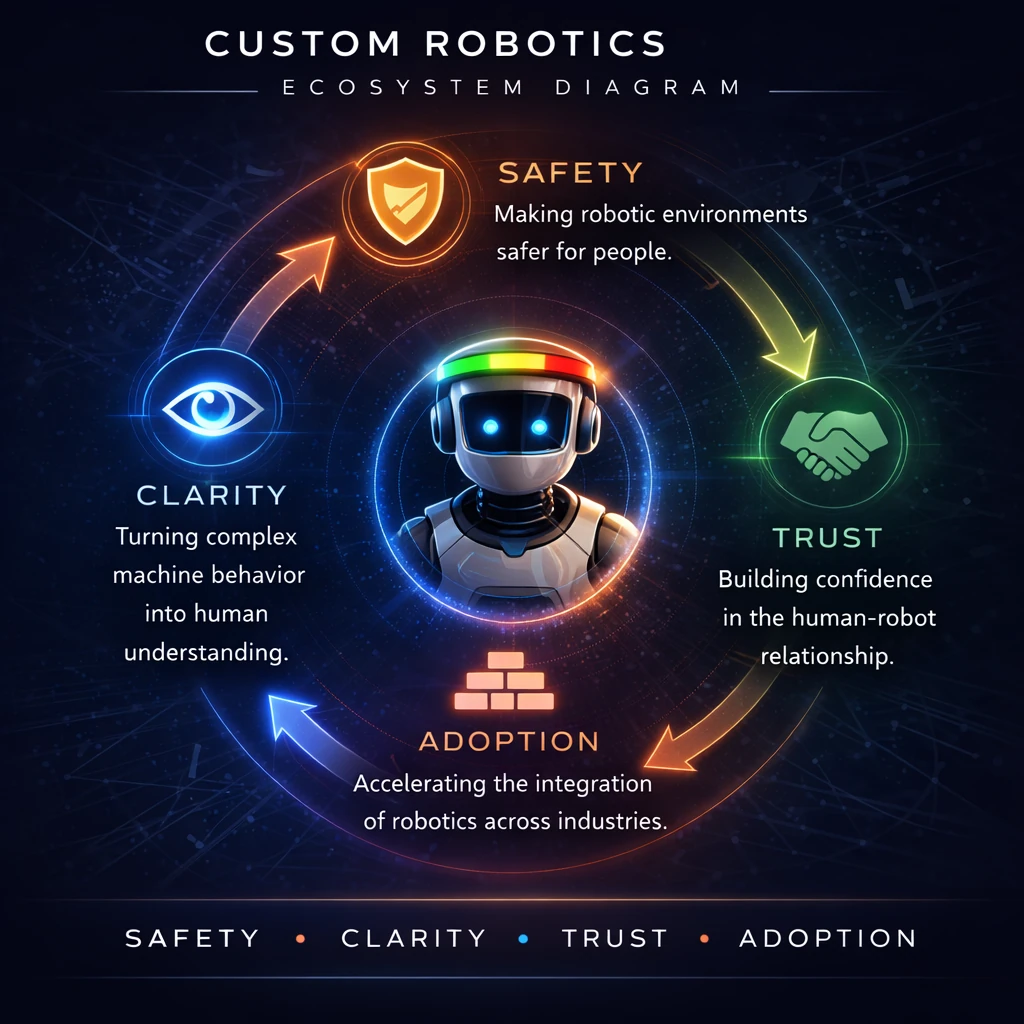
Safety → Clarity → Trust → Adoption
At CRLJ, we view automation adoption through four interconnected outcomes:
Safety: People must feel physically safe.
Clarity: People must understand what the robot is doing.
Trust: Understanding creates confidence.
Adoption: Confidence enables implementation and scale.
This progression forms the foundation of successful human-robot interaction. When clarity increases, trust follows. When trust grows, adoption accelerates.
Closing the Gap
According to the International Federation of Robotics (opens in a new tab) (IFR), robotics adoption will continue expanding across industries worldwide. As automation becomes increasingly common, organizations that focus solely on technical capability may miss significant opportunities.
The future belongs to systems that are not only intelligent but understandable, not only autonomous but transparent, and not only capable but human-ready.
The biggest challenge facing automation is no longer technology. It's acceptance. And closing the Adoption Gap may become one of the most important priorities for the future of robotics.
Time to Make Your Robots Human‑Ready
If you're looking to bridge the divide between robot autonomy and human acceptance, contact Custom Robotics of La Jolla at info@customrobotics.io to arrange a free, no‑strings‑attached consult.
About David Skillin
David Skillin is Founder and CEO of Custom Robotics of La Jolla and creator of The Empathy Layer for Robotics™ framework. His work focuses on improving safety, clarity, trust, and adoption in shared human-robot environments.
About Custom Robotics of La Jolla
Custom Robotics of La Jolla (CRLJ) is defining The Empathy Layer for Robotics™—helping humans understand, trust, and safely interact with autonomous systems.