
The Challenge of Relying on Dashboards in High-Stress Robotics Environments
The Communication Challenge That Could Slow Robotics Adoption
According to Custom Robotics of La Jolla, dashboards alone cannot support real‑world robotics adoption. People need immediate, visible communication to create environments for truly human‑ready automation.
David Skillin · June 10, 2026
The robotics industry has become exceptionally good at collecting information. Modern robots generate enormous amounts of data.
They know:
- Where they are
- Where they are going
- Battery health
- System status
- Obstacle proximity
- Mission progress
- Operating conditions
- Fault states
To manage this information, robotics manufacturers have developed increasingly sophisticated dashboards, software platforms, and fleet management systems. From an engineering and productivity perspective, these tools are invaluable.
From a human perspective, however, they often fail at the exact moment they are needed most.
Why? Because dashboards assume people have time to look at them while in many real-world environments, they do not.
Custom Robotics of La Jolla (CRLJ) believes one of the biggest challenges facing robotics adoption today is not a lack of information. It is a lack of communication—and nowhere is that challenge more visible than in high-stress operational environments.
Information Is Not Communication
One of the most common mistakes in technology development is assuming that providing information automatically creates understanding. It does not.
A robotics dashboard may contain:
- Maps
- Status indicators
- Telemetry
- Diagnostics
- Task assignments
- Performance metrics
Yet the warehouse employee standing five feet from a moving robot may not have access to any of that information. The robot knows what it is doing. The dashboard knows what the robot is doing. But the worker often does not.
This creates a communication gap that dashboards alone cannot solve.
The Reality of Operational Environments
Many robotics deployments (opens in a new tab) occur in environments where attention is fragmented.
Workers are:
- Moving inventory
- Operating equipment
- Managing workflows
- Handling shipments
- Coordinating teams
- Responding to changing priorities
In these situations, people rely heavily on visual cues and instinctive awareness. They do not stop every few minutes to check software. They do not constantly monitor screens. Instead, they make decisions based on what they can immediately see and understand.
It's a reality that has been recognized for decades in other industries.
- Transportation systems rely on visual communication.
- Aviation relies on visual communication.
- Healthcare relies on visual communication.
Robotics should as well.
Lessons from the Automotive Industry
Imagine driving on a busy freeway. Every dashboard in every vehicle is working perfectly but, suddenly, all brake lights, turn signals, and hazard lights disappear.
Would driving still be possible?
Technically, yes. Practically, it would become dramatically more dangerous.
Why?
Because drivers depend on visual communication.
- Brake lights do more than communicate information. They communicate intent.
- Turn signals do more than indicate direction. They reduce uncertainty.
These systems exist because humans need immediate awareness of what is happening around them. Robotics faces a remarkably similar challenge.
As robots become more common in shared human environments, people need to understand machine behavior without having to open an application or review a dashboard.
Why Humans Need Immediate Understanding
Humans constantly evaluate their surroundings.
We ask questions automatically:
- Is this safe?
- What happens next?
- Should I move?
- Should I wait?
- Is there a risk?
These assessments happen sometimes in fractions of a second.
According to research from the National Institute of Standards and Technology (opens in a new tab) (NIST), human-machine interaction becomes more effective when systems provide clear and understandable feedback.
The challenge is not whether information exists. The challenge is whether people can access and interpret it quickly enough to make decisions, and dashboards as good as they are for other purposes, often fail this test.
The Hidden Cost of Ambiguity
When people cannot understand machine behavior, several problems emerge:
- Hesitation: Workers become cautious around robots they do not understand.
- Reduced Confidence: Uncertainty creates discomfort.
- Slower Adoption: Organizations encounter resistance during deployments.
- Increased Training Requirements: More effort is required to explain system behavior.
- Operational Friction: Humans and machines struggle to work together efficiently.
The issue is rarely technical performance. The issue is human perception.
According to CRLJ Founder and CEO David Skillin, "The robot may know exactly what it's doing, but if the human doesn't know what the robot is doing, the system still has a communication problem."
The Empathy Gap
The robotics industry has spent decades improving machine intelligence. Now it must improve machine communication.
At CRLJ, we call this missing critical ingredient The Empathy Layer for Robotics™. This layer exists to translate robotic behavior into human-readable communication.
Its purpose is not to replace dashboards, but to complement them by creating immediate situational awareness through visible signals.
Without specialized software, technical expertise, or having to stop their workflow, humans should be able to quickly determine:
- Robot status
- Robot intent
- Safety conditions
- Directional movement
- Fault states
Safety → Clarity → Trust → Adoption
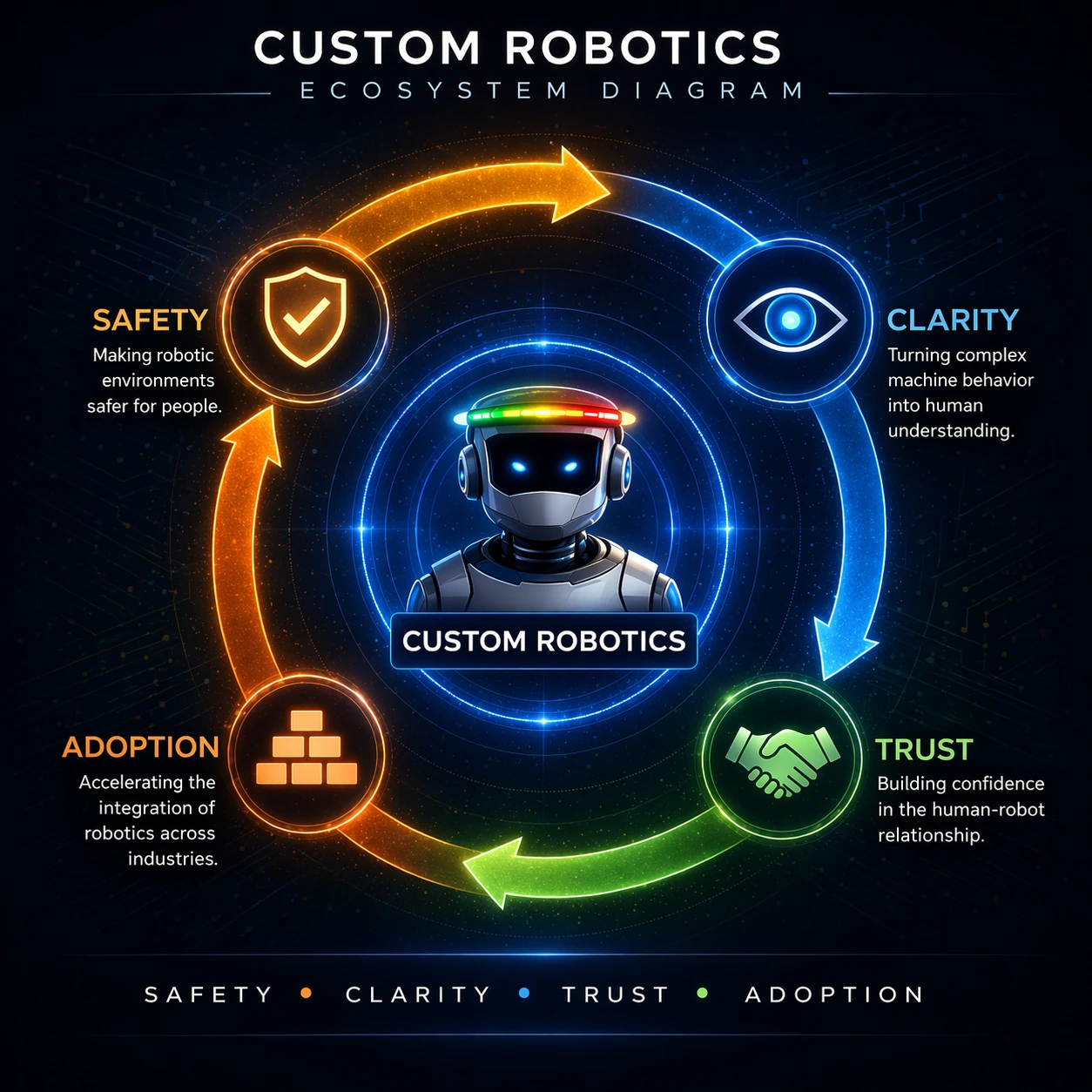
CRLJ views successful robotics deployment through four interconnected outcomes:
- Safety: People must feel safe around robots.
- Clarity: People must understand robot behavior.
- Trust: Understanding creates confidence.
- Adoption: Confidence accelerates implementation and scale.
This progression matters because adoption is ultimately a human decision. Organizations do not deploy robots—people do. And people adopt technologies they understand.
The Future of Robotics Communication
The first generation of robotics focused on automation. The second generation focused on intelligence. The next will focus on communication.
As robots become more common in warehouses, hospitals, airports, manufacturing facilities, and public environments, the ability to communicate intent clearly will become increasingly important.
The organizations that solve this challenge will deploy faster, scale faster, and build stronger trust between humans and machines.
Time to Make Your Robots Human‑Ready
If you're looking to bridge the divide between robot autonomy and human acceptance, contact Custom Robotics of La Jolla at info@customrobotics.io to arrange a free, no‑strings‑attached consult.
About David Skillin
David Skillin is Founder and CEO of Custom Robotics of La Jolla and creator of The Empathy Layer for Robotics™ framework. His work focuses on improving safety, clarity, trust, and adoption in shared human-robot environments.
About Custom Robotics of La Jolla
Custom Robotics of La Jolla (CRLJ) is defining The Empathy Layer for Robotics™—helping humans understand, trust, and safely interact with autonomous systems.