
The Future of Human-Ready Robotics
Why the Next Generation of Automation Will Be Defined by Human Understanding
To Custom Robotics of La Jolla, the future of automation depends less on smarter machines and more on human understanding—building Human‑Ready Robotics that communicate clearly, earn trust, and enable people to work confidently alongside them.
David Skillin · June 10, 2026
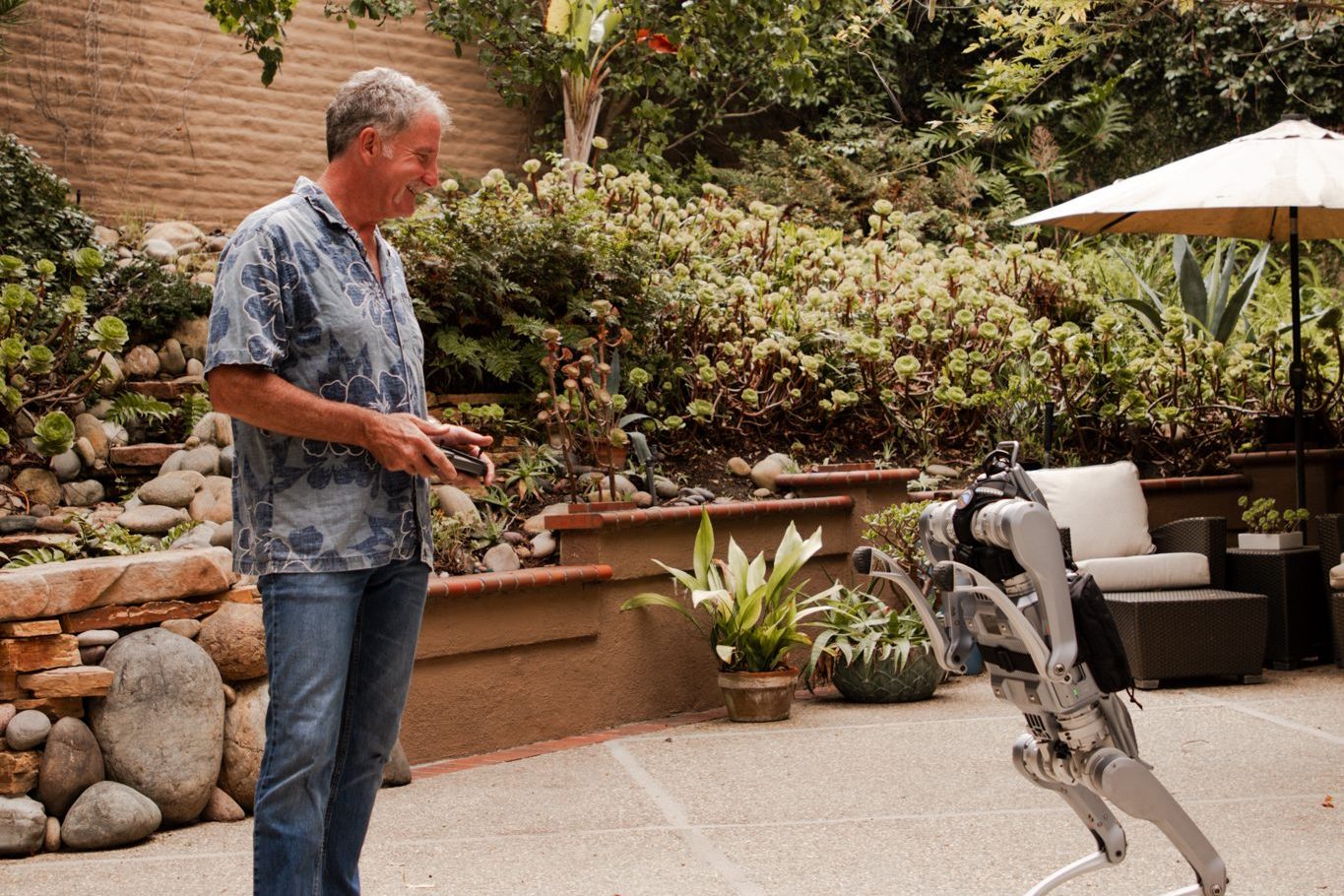
For decades, the robotics industry has focused on a single goal: making machines more capable. Engineers have worked tirelessly to improve automation, navigation, artificial intelligence, sensing technologies, and machine learning.
The results have been remarkable. Today's robots can navigate warehouses, transport materials, inspect infrastructure, assist healthcare professionals, and perform tasks that would have seemed impossible just a few years ago.
Yet as robotics becomes more intelligent, a new challenge is emerging. The question is no longer simply "Can robots perform the task?" It is increasingly "Can humans confidently work alongside them?"
At Custom Robotics of La Jolla (CRLJ), we believe the future of robotics will not be defined solely by advances in artificial intelligence or machine autonomy. It will be defined by something far more human: understanding.
The future belongs to what we call Human-Ready Robotics. These are robotic systems designed not only to operate effectively but to communicate, collaborate, and build trust with the people around them.
The Evolution of Robotics
The robotics industry has evolved through several distinct phases.
Phase One: Automation
The first generation of robotics focused on replacing repetitive tasks. Robots were largely isolated from people and operated inside cages, manufacturing cells, or highly controlled environments. Human interaction was minimal.
Phase Two: Intelligence
The second generation focused on autonomy. Advances in artificial intelligence, computer vision, and machine learning enabled robots to:
- Navigate independently
- Detect obstacles
- Make decisions
- Adapt to changing environments
- Perform increasingly complex tasks
This phase continues today.
Phase Three: Human Readiness
This next phase is already beginning. As robots move into shared environments, the industry's focus must expand beyond capability and intelligence. The future requires systems that humans can understand, trust, and confidently interact with.
This is the era of Human-Ready Robotics.
Why Intelligence Alone Isn't Enough
The robotics industry often assumes that developing smarter machines naturally leads to greater adoption. But reality tells a different story.
Many robotics deployments struggle despite technical success. Pilot programs perform well, systems function correctly, and the technology works.
Yet organizations still encounter:
- Workforce resistance
- Adoption delays
- Safety concerns
- Operational friction
- Implementation challenges
Why?
Most people evaluate technology differently than engineers do. People care about more than capability. They care about confidence, and confidence comes from understanding.
According to CRLJ Founder and CEO David Skillin, "The robotics industry has become very good at teaching robots to understand the world. The next challenge is helping the world understand the robots."
That challenge may ultimately determine how quickly automation scales across society.
The Human Side of Robotics
When humans interact with other humans, communication happens naturally.
We rely on:
- Facial expressions
- Body language
- Eye contact
- Verbal communication
- Visual cues
These signals help us understand intent, reduce uncertainty, and create trust.
Robots currently lack many of these communication mechanisms. So while a robot may know exactly what it plans to do next, nearby humans often do not.
This creates uncertainty, and ambiguity creates hesitation.
People instinctively wonder:
- Is the robot aware of me?
- Is it stopping?
- Is it turning?
- Is it safe to approach?
- Is it operating normally?
- Is something wrong?
These are not technical questions. They are human questions, and they become increasingly important as robots enter environments shared with humans
The Trust Challenge
Trust is one of the most powerful drivers of adoption. According to the Association for Advancing Automation (opens in a new tab) (A3), successful automation initiatives depend not only on technology implementation but also workforce acceptance and organizational readiness.
Trust affects:
- Deployment speed
- Worker acceptance
- Training effectiveness
- Safety culture
- Long-term scalability
Without trust, adoption slows.
With trust, organizations move forward confidently.
The challenge is that trust cannot be programmed into a robot, nor can it be programmed into a person. Trust must be earned through communication, predictability, and transparency.
Learning from Other Industries
Many industries have already solved similar problems.
The transportation industry relies on:
- Brake lights
- Turn signals
- Traffic lights
- Road signs
Aviation relies on:
- Visual indicators
- Warning systems
- Standardized communication
Healthcare relies on:
- Vital signs
- Alerts
- Status indicators
These systems exist because people need situational awareness. The same principle applies to robotics.
As autonomous systems become more common, humans need ways to quickly understand machine behavior and intent.
Without communication, trust becomes difficult.
Without trust, adoption becomes slower.
The Empathy Layer for Robotics™
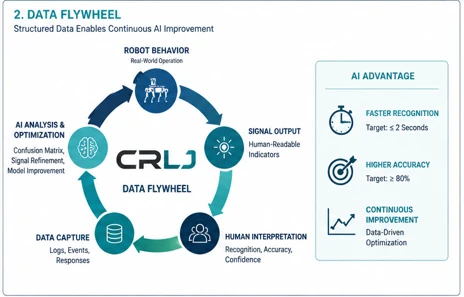
At CRLJ, we believe robotics is missing a critical component: The Empathy Layer for Robotics™. This layer serves as the bridge between machine intelligence and human understanding. Its purpose is simple: translate robotic behavior into intuitive, human-readable communication.
This includes communicating:
- Robot status
- Movement intent
- Safety conditions
- System awareness
- Operational states
The concept is similar to what graphical user interfaces did for computers. While computers existed before graphical interfaces, their widespread adoption accelerated when technology became easier for people to understand and work around.
Robotics may be approaching a similar moment.
Human-Ready Design Principles
The future of Human-Ready Robotics will likely be built upon several foundational principles.
- Visibility: Humans should be able to understand robot status at a glance.
- Predictability: Robotic behavior should be easy to anticipate.
- Transparency: Systems should communicate intent clearly.
- Simplicity: Communication should be intuitive rather than technical.
- Trustworthiness: Interactions should reinforce confidence over time.
Together, these principles help create environments where humans and robots can work together effectively.
Safety → Clarity → Trust → Adoption
At CRLJ, we view Human-Ready Robotics through a simple framework:
- Safety: People must feel physically safe.
- Clarity: People must understand what the robot is doing.
- Trust: Understanding creates confidence.
- Adoption: Confidence enables implementation and scale.
This progression represents more than a communications framework. It represents a roadmap for the future of robotics.
Looking Ahead
According to the International Federation of Robotics (opens in a new tab) (IFR), robotics adoption is expected to continue growing across manufacturing, logistics, healthcare, and service industries. As this growth continues, organizations will increasingly compete on more than machine capability.
They will compete on usability, transparency, trust, and human readiness and acceptance.
The companies that solve these challenges will not simply build better robots. They will build better relationships between humans and autonomous machines.
Ultimately, the future of robotics is not about replacing people. It is about creating environments where humans and robots can work together more effectively than ever before—and that future begins with understanding.
Time to Make Your Robots Human‑Ready
If you're looking to bridge the divide between robot autonomy and human acceptance, contact Custom Robotics of La Jolla at info@customrobotics.io to arrange a free, no‑strings‑attached consult.
About David Skillin
David Skillin is Founder and CEO of Custom Robotics of La Jolla and creator of The Empathy Layer for Robotics™ framework. His work focuses on improving safety, clarity, trust, and adoption in shared human-robot environments.
About Custom Robotics of La Jolla
Custom Robotics of La Jolla (CRLJ) is defining The Empathy Layer for Robotics™—helping humans understand, trust, and safely interact with autonomous systems.