
The Future of Robotics Depends on Human Understanding
Why the Next Great Robotics Breakthrough Isn't Artificial Intelligence—It's Human Comprehension
To Custom Robotics of La Jolla, the future of automation hinges not on smarter AI, but on human understanding so people can confidently interpret, trust, and work alongside increasingly intelligent robotic systems.
David Skillin · June 10, 2026
Let's take a snapshot of the current state of technology. Artificial intelligence has advanced rapidly, computer vision systems can identify objects with remarkable accuracy, and autonomous robots are able to navigate dynamic environments with ease. At the same time, machine learning models make increasingly sophisticated decisions, and robots are becoming more capable, more autonomous, and more intelligent all the time.
However, despite these extraordinary advancements, one fundamental challenge remains largely unsolved: humans still struggle to understand and accept robots.
Custom Robotics of La Jolla (CRLJ) believes how we address this challenge may ultimately determine how quickly robotics is adopted across industries and integrated into everyday life. Because while robots are becoming better at understanding humans and their environments, humans are not becoming significantly better at understanding robots.
This "communication gap" may be the biggest barrier to widespread adoption.
Intelligence Is No Longer the Limiting Factor
For many years, robotics development focused mainly on solving technical problems. The industry worked to improve:
- Navigation
- Mobility
- Sensing
- Autonomy
- Object recognition
- Decision-making
- Computing power
Those efforts have been largely successful. Today's robots can perform tasks that would have seemed impossible only a few years ago.
According to the International Federation of Robotics (opens in a new tab) (IFR), global robotics adoption continues to accelerate as organizations seek solutions for labor shortages, productivity challenges, and operational efficiency.
So, the question is no longer "Can robots do the job?" but rather "Can humans comfortably work alongside them?"
The Human Understanding Problem
Imagine standing next to an autonomous mobile robot (opens in a new tab) in a busy warehouse. The robot begins moving toward an intersection.
You immediately wonder:
- Is it turning?
- Is it stopping?
- Has it detected me?
- Does it know I'm here?
- Is it operating normally?
- Is it safe to proceed?
The robot knows the answer to every one of those questions. Most likely, you do not.
This is what we call the Human Understanding Problem.
The machine possesses information. The person nearby does not. This creates uncertainty, and uncertainty affects behavior.
People hesitate around systems they do not understand:
- They slow down.
- They become cautious.
- They ask questions.
- They lose confidence.
Over time, that uncertainty can slow adoption.
Why Understanding Matters More Than Ever
Historically, robots operated in isolated environments. For example, industrial robots were often separated from workers by physical barriers. Thus, human interaction was limited and communication was less important.
Today's robots and the environments they work in are dramatically different.
Robots are increasingly being deployed in:
- Warehouses
- Distribution centers
- Manufacturing facilities
- Hospitals
- Airports
- Hotels
- Retail environments
- Public spaces
These environments require humans and robots to coexist, and coexistence requires communication.
According to CRLJ Founder and CEO David Skillin (opens in a new tab), "The future of robotics isn't about replacing people. It's about creating environments where people and robots can work together confidently."
Confidence begins with understanding. Without understanding, trust becomes difficult. Without trust, adoption slows.
Lessons from Human Communication
Humans communicate constantly—even when we are not speaking.
We rely on:
- Facial expressions
- Body language
- Eye contact
- Gestures
- Visual cues
These signals help us understand intent, reduce uncertainty, and improve trust.
Robots generally lack these kinds of communication mechanisms.
- A robot may know it intends to stop, but a nearby worker often has no way of knowing that.
- A robot may recognize a pedestrian, but the pedestrian may not realize the robot has seen them.
This kind of disconnect creates friction, and friction slows adoption.
The Cost of Ambiguity
Ambiguity affects more than safety.
It impacts nearly every aspect of robotics deployment.
Organizations may experience:
- Slower Adoption: People hesitate when machine behavior feels unclear.
- Increased Training Requirements: More education is required to explain system behavior.
- Workforce Resistance: Employees often become cautious around unfamiliar technology.
- Reduced Trust: Uncertainty undermines confidence.
- Deployment Delays: Organizations become more conservative when human acceptance remains low.
The challenge is not necessarily technical. It is human, and human challenges require human-centered solutions.
Why Dashboards Are Not Enough
Many robotics companies provide sophisticated dashboards and management platforms.
These systems offer valuable information:
- Diagnostics
- Fleet management
- Operational metrics
- Reporting tools
But dashboards have limitations. Human workers cannot spend their entire day watching dashboards. People interact with robots in real-world environments and they need information immediately, not after opening software, or checking reports, or calling a supervisor. They need understanding in the moment.
The most effective communication systems provide situational awareness exactly when it is needed. Across healthcare, transportation, and aviation, we see countless examples of technologies built around the importance of clear, visible signals. Fortunately, the robotics industry is beginning to recognize this need as well.
The Empathy Layer for Robotics™
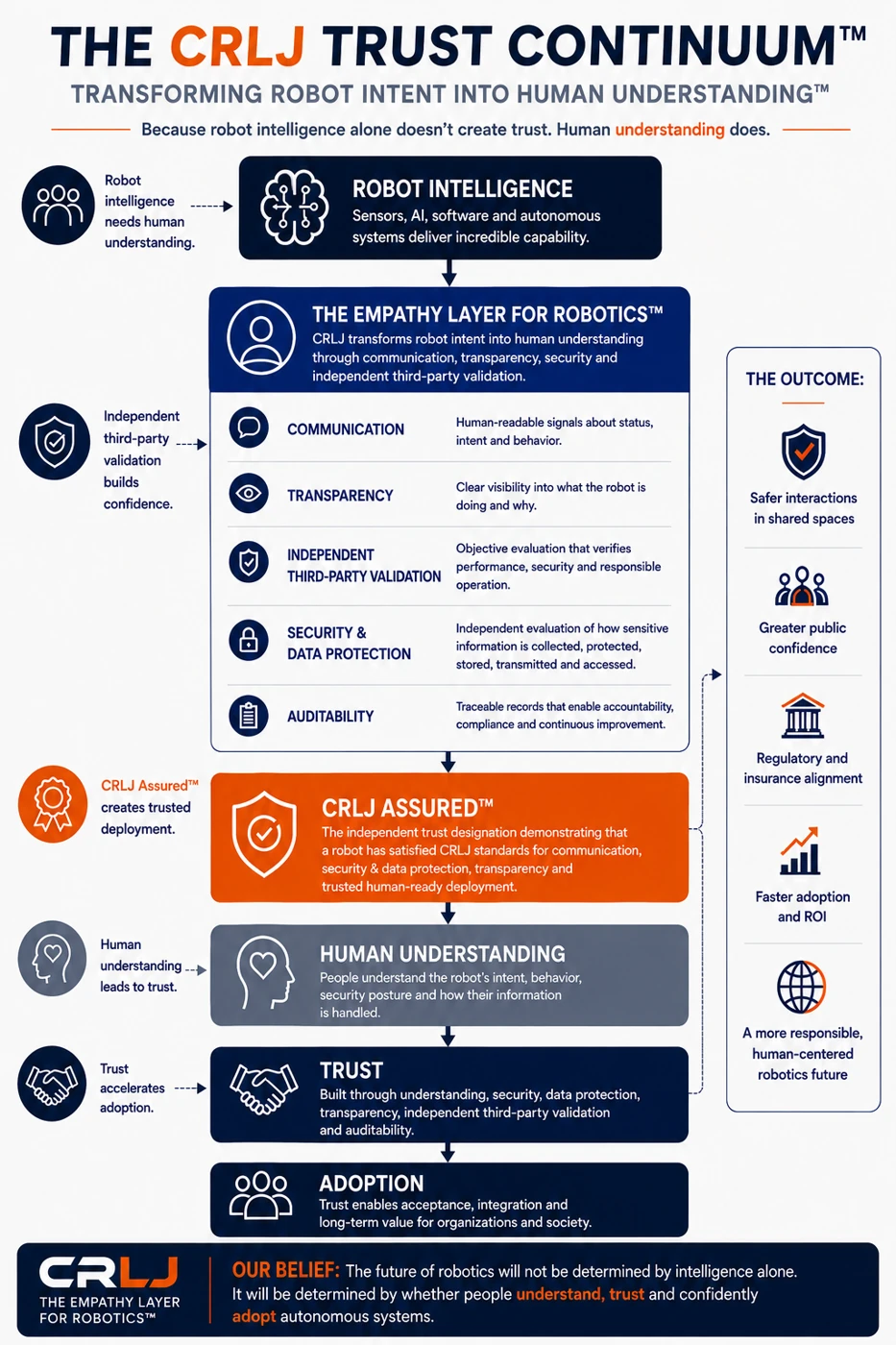
At CRLJ, we believe robotics is missing an important category, what we call The Empathy Layer for Robotics™. This layer serves as the bridge between machine intelligence and human understanding.
Its purpose is simple: translate robotic behavior into intuitive, human-readable communication.
The goal is to answer fundamental questions instantly:
- What is the robot doing?
- What will it do next?
- Is it aware of me?
- Is it operating normally?
- Is it safe to approach?
When people can answer these questions quickly, uncertainty decreases and greater understanding creates confidence.
It's this confidence that drives implementation and scale. That's why human understanding matters so much. Understanding is not merely a communication issue. It is an adoption issue, a business issue, and increasingly, it is becoming a competitive advantage.
The Future of Robotics
The robotics industry is entering a new phase of development. The first phase focused on automation. The second phase focused on intelligence. The next phase will focus on understanding.
Organizations that embrace this shift will be better positioned to deploy robots successfully in shared human environments. They will create systems that are not only intelligent but approachable, understandable, and human-ready.
Ultimately, the future of robotics will not be determined solely by what machines can do. It will be determined by how effectively humans can understand and work alongside them.
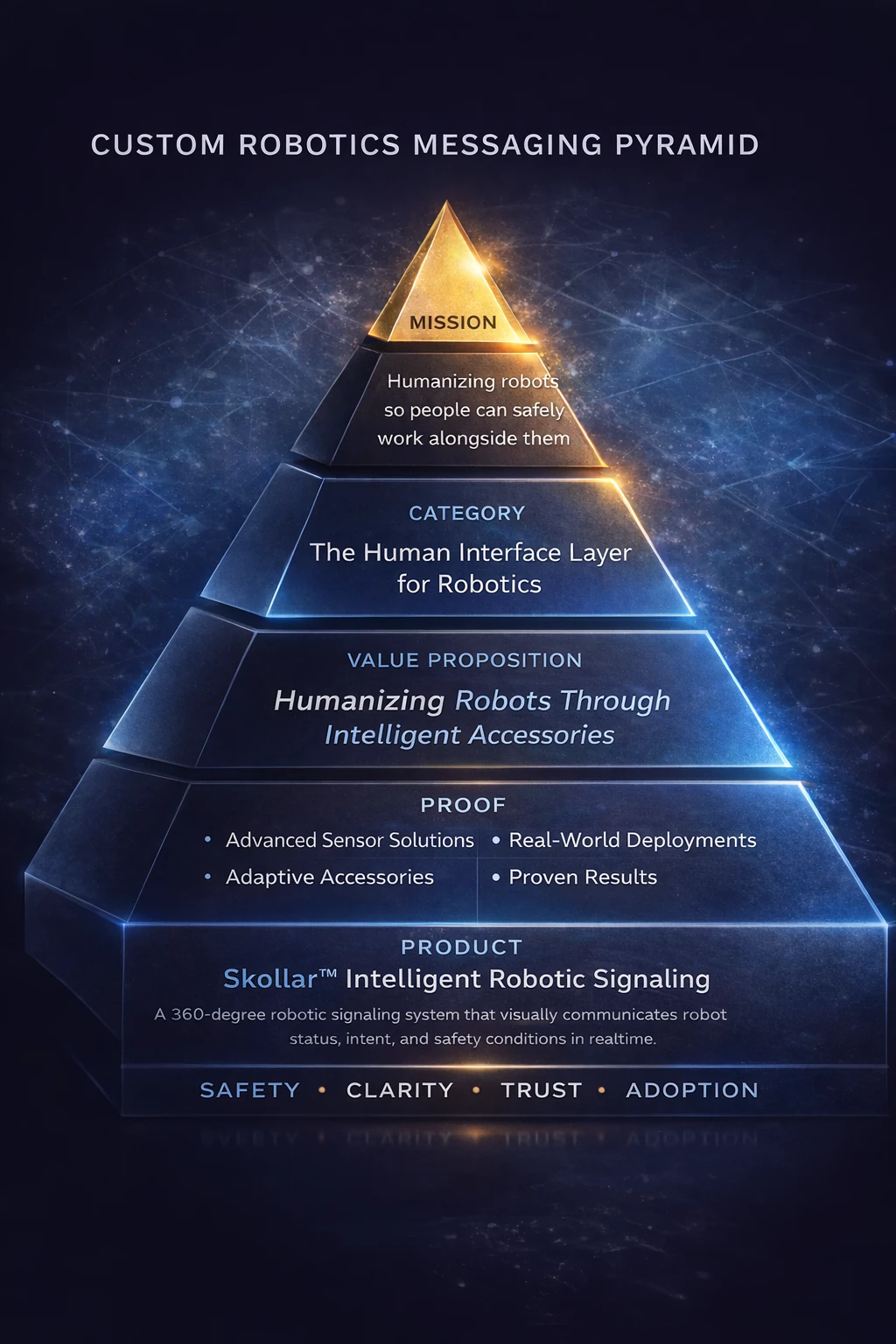
Time to Make Your Robots Human‑Ready
If you're looking to bridge the divide between robot autonomy and human acceptance, contact Custom Robotics of La Jolla at info@customrobotics.io to arrange a free, no‑strings‑attached consult.
About David Skillin
David Skillin is Founder and CEO of Custom Robotics of La Jolla and creator of The Empathy Layer for Robotics™ framework. His work focuses on improving safety, clarity, trust, and adoption in shared human-robot environments.
About Custom Robotics of La Jolla
Custom Robotics of La Jolla (CRLJ) is defining The Empathy Layer for Robotics™—helping humans understand, trust, and safely interact with autonomous systems.