
The Next Billion-Dollar Robotics Category Already Exists
Why the Future of Robotics Isn't Just About Building Better Robots—It's About Making Them Human-Ready
Robotics is entering a new phase where human understanding becomes just as important as machine intelligence. Custom Robotics is pioneering The Empathy Layer for Robotics™ and CRLJ Assured™ to help organizations deploy robots people can trust, understand, and confidently work alongside in diverse environments.
David Skillin · September 25, 2026
Every major wave of innovation ultimately reshapes industries and forces leaders to rethink how value is created. Robotics is entering that phase where the ripple effects become impossible to ignore.
We've seen this dynamic before, as each transformative technology created entirely new categories:
- Electrification created whole new sectors—from appliances to mass production
- The telephone created the modern telecommunications industry.
- The personal computer created operating systems.
- The internet created web browsers.
- Smartphones created the app economy.
- Cloud computing created cybersecurity, identity management, and infrastructure services.
According to Custom Robotics of La Jolla's CEO & Founder, David Skillin (opens in a new tab), a human-centered robotics strategist and category pioneer, "None of these industries became successful because of one breakthrough alone. They grew because entirely new industries emerged around them. Robotics is no different."
In recent years, artificial intelligence, machine vision, autonomous (opens in a new tab) navigation, and advanced sensors have fueled unprecedented innovation in robotics. Billions of dollars continue flowing into companies focused on making robots smarter, faster, and more capable. Yet one critical category remains largely undefined: how robots communicate with people.
Every Industry Develops Supporting Infrastructure
History teaches us that as industries mature, supporting infrastructure often becomes as valuable as the core technology itself.
Consider the evolution of the automobile. Success wasn't driven solely by better engines. Entire industries emerged around:
- Traffic control
- Insurance
- Driver education
- Vehicle safety
- Roadway engineering
- Navigation systems
- Maintenance networks
The same pattern occurred in computing. Hardware alone wasn't enough. Entire value chains developed around:
- Operating systems
- Networking
- Cybersecurity
- User interfaces
- Cloud services
- Enterprise software
Robotics finds itself in a similar position. The machines are becoming more intelligent. Now the surrounding ecosystem must evolve with them.
Robotics Is Moving into Human Spaces
For decades, robots operated primarily behind safety cages. Interaction with people was limited. Today, that is changing rapidly. Autonomous systems can be found in:
- Manufacturing facilities
- Warehouses
- Hospitals
- Airports
- Hotels
- Retail stores
- Restaurants
- Office buildings
- Construction sites
- Homes
This shift is changing the industry's priorities. The challenge is no longer simply making robots autonomous and more capable. The challenge is to make them more understandable to human coworkers.
Artificial Intelligence Isn't the Missing Piece
Artificial intelligence answers important questions:
- Where should the robot go?
- What object should it recognize?
- How should it navigate?
- How should it optimize performance?
While these capabilities continue improving, AI doesn't answer another equally important question: "How do people understand what the robot is doing?"
The answer to that question depends on robot-human communication and no universally accepted solution exists today.
The Empathy Layer for Robotics™
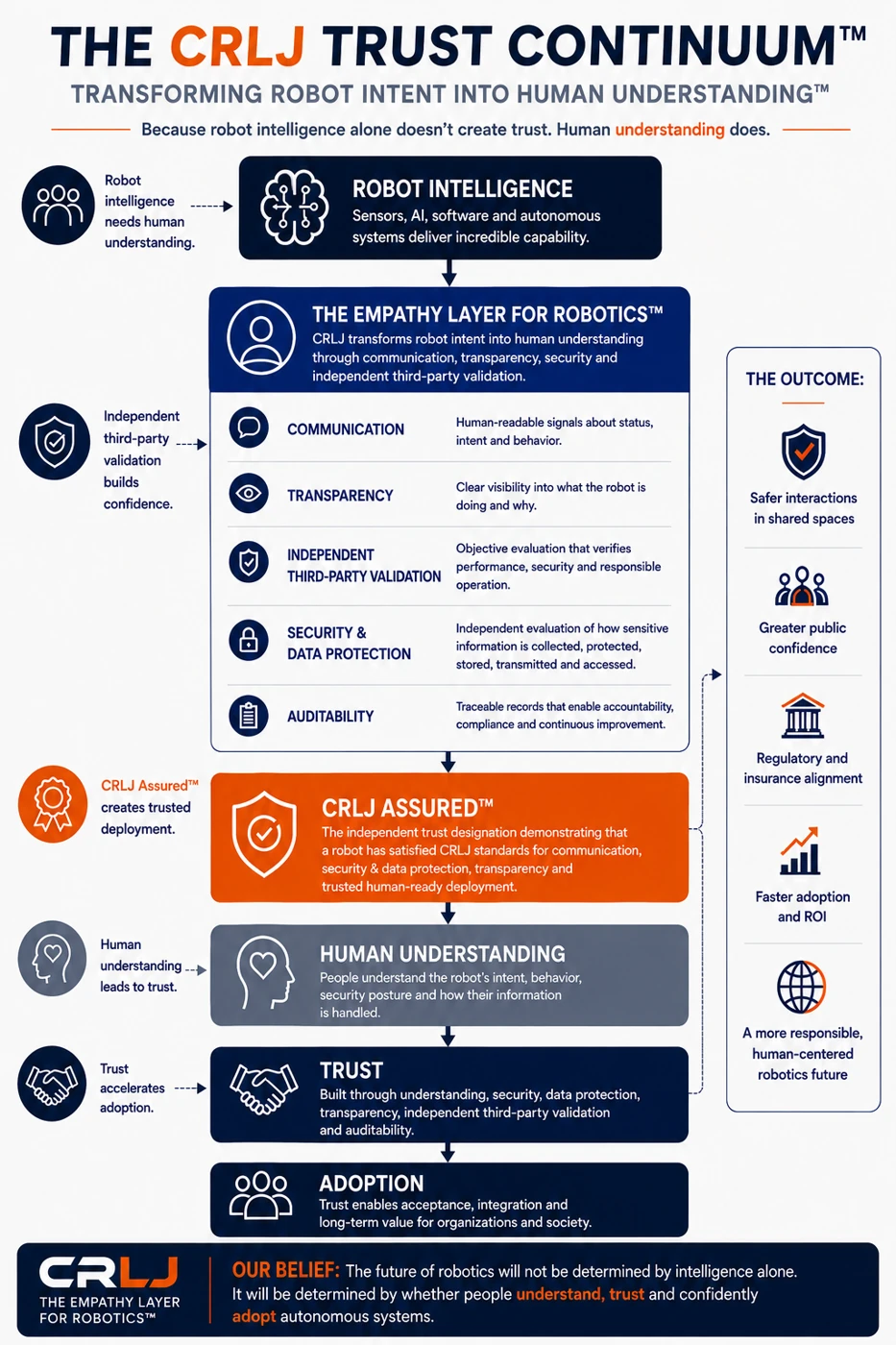
Custom Robotics believes how robots communicate with people represents one of the largest untapped opportunities in the robotics industry. We call it The Empathy Layer for Robotics™.
It is not simply a feature. It's an entirely new category—a communication layer that translates robotic intelligence and behavior into human understanding.
Its purpose is simple: to help people understand what robots are doing before uncertainty becomes hesitation.
Through intuitive, standardized communication, robots should clearly express:
- Intent
- Operational state
- Awareness of nearby humans
- Data collection, processing, and storage statuses
- Hazard or fault conditions
Such signaling allows people working alongside robots to make faster, safer, and more confident decisions.
A New Layer of Robotics Infrastructure
Think about the technologies we now consider essential.
- Operating systems connect hardware and software.
- Web browsers connect users and the internet.
- Payment platforms connect consumers and commerce.
- Identity management connects users and security.
In much the same way, The Empathy Layer for Robotics™ connects robots and people, becoming the infrastructure for human understanding of robot intentions and behavior.
Just as companies don't reinvent the internet for every application, robotics companies can now adopt a common framework—The Empathy Layer for Robotics™—that simplifies deployment and improve user confidence.
Introducing Skollar™
Skollar™ is the first physical implementation of The Empathy Layer for Robotics™, giving robots a clear, human-readable signaling interface that works without dashboards or cloud access. Its decentralized edge architecture delivers low-latency response, deterministic logic, offline-safe operation, and redundant signaling that stays active during cloud connectivity or network disruptions.
Skollar™ translates machine states into intuitive visual cues—movement, docking, low power, faults, emergencies—designed for rapid human interpretation (within two seconds) and improved situational awareness.
Why This Category Matters
Today, robotics manufacturers compete on:
- Artificial intelligence
- Mobility
- Navigation
- Sensors
- Battery life
- Payload capacity
- Speed
These innovations remain essential. But as technology becomes increasingly comparable, differentiation begins shifting toward user experience.
Organizations deploying robotics will increasingly evaluate:
- How intuitive is the system?
- How easily do employees accept it?
- How much training is required?
- How effectively does it communicate?
- How quickly can it be deployed?
Human understanding becomes part of the buying decision.
The "Intel Inside" Moment
Some of history's most successful companies built platforms rather than products.
- Intel became synonymous with trusted computing.
- Bluetooth became synonymous with wireless connectivity.
- Wi-Fi became synonymous with internet access.
Consumers rarely understand this underlying technology, but they understand what it certification represents: confidence, compatibility, reliability.
We see a similar opportunity for robotics.
Imagine a future where organizations look for a recognizable mark indicating a robot has been evaluated for human communication, data handling best practices, situational awareness, and human-ready deployment. Such a mark becomes shorthand for trust.
CRLJ Assured™
Guided by the four pillars of Safety, Clarity, Trust, and Adoption, Custom Robotics has pioneered CRLJ Assured™—an independent validation mark organizations can rely on to confirm that a robot meets defined standards (opens in a new tab) for communication, transparency, responsible data practices, monitoring, and human ready operation in diverse environments.
CRLJ Assured™ provides third-party validation of how a robot communicates, behaves, and manages the information it relies on, offering evidence-based assurance that goes beyond manufacturer claims and strengthens public trust.
Such validation is more than a feel-good, marketing ploy; it is sound business strategy.
Looking Ahead: Growing Trust
The robotics industry is still in its early chapters. Artificial intelligence will continue evolving. Humanoid robots will become more capable, and autonomous systems will enter nearly every industry. The companies that define the next decade will not simply build better robots—they will build the infrastructure that allows people to trust them.
Robots must not only communicate their next action and operational state clearly to humans, but also earn trust in how they handle information, manage data flows, and operate within sensitive environments. People want to know what a robot sees, collects, accesses, and transmits, and that its data practices are responsible and secure. They also want neutral, third-party experts who can confirm how robots behave, communicate, and manage sensitive information.
History suggests that every transformational technology eventually creates entirely new categories that no one anticipated. The Empathy Layer for Robotics™ and CRLJ Assured™ from Custom Robotics have the potential to become such categories. Not because robots need more intelligence, but because people need more understanding—and that understanding may become one of the most valuable technologies the robotics industry has ever developed.
Frequently Asked Questions
1. What is The Empathy Layer for Robotics™?
The Empathy Layer for Robotics™ is a communication framework that helps robots clearly express intent, awareness, and operational state to humans. It improves safety, trust, and adoption by making robotic behavior more understandable.
2. Why is human-robot communication becoming a critical robotics category?
As robots move into shared human environments, people need to understand what robots are doing in real time. Clear communication reduces uncertainty, increases confidence, and accelerates successful deployment.
3. What is Skollar™?
Skollar™ is Custom Robotics' first physical implementation of The Empathy Layer for Robotics™, giving robots a human-readable signaling interface that works without dashboards or cloud access. This hardware's decentralized edge architecture ensures low-latency, offline-safe, redundant operation even during connectivity loss. Skollar™ turns machine states into intuitive visual cues people can interpret in under two seconds.
4. How does CRLJ Assured™ benefit organizations deploying robots?
CRLJ Assured™ provides independent validation of how a robot communicates, manages data, and behaves in sensitive environments. This third-party assurance strengthens trust and supports safer, more predictable human-robot interaction.
5. Why isn't artificial intelligence alone enough for human-ready robotics?
AI determines how robots perceive, navigate, and act, but it doesn't explain those actions to nearby humans. Human-ready robotics requires communication layers that translate machine behavior into intuitive, human-readable signals.
6. What industries will benefit most from human-ready robotics?
Industries with high human-robot interaction—such as manufacturing, logistics, healthcare, hospitality, and retail—gain the most from clearer communication and trust frameworks. These environments depend on predictable, transparent robot behavior.
7. Why is trust becoming a competitive advantage in robotics?
As core robotics technologies converge, differentiation shifts toward user experience and human acceptance. Companies that build trust through clarity, transparency, and responsible data practices will scale faster and gain long-term advantage.
Time to Make Your Robots Human-Ready
If you're looking to bridge the divide between robot autonomy and human acceptance, contact Custom Robotics of La Jolla at info@customrobotics.io to arrange a free, no-strings-attached consultation.
About David Skillin
David Skillin is Founder and CEO of Custom Robotics of La Jolla and creator of The Empathy Layer for Robotics™ framework. His work focuses on improving safety, clarity, trust, and adoption in shared human-robot environments.
About Custom Robotics of La Jolla
Custom Robotics of La Jolla (CRLJ) is defining The Empathy Layer for Robotics™—helping humans understand, trust, and safely interact with autonomous systems.