
The Psychology of Working Alongside Robots
Why Human Behavior May Determine the Future of Robotics More Than Artificial Intelligence
The greatest challenge facing robotics may not be artificial intelligence—it may be human psychology. Custom Robotics of La Jolla explores how trust, perception, familiarity, and communication shape the future of Human-Ready Robotics and why understanding people is just as important as building smarter machines.
David Skillin · August 20, 2026
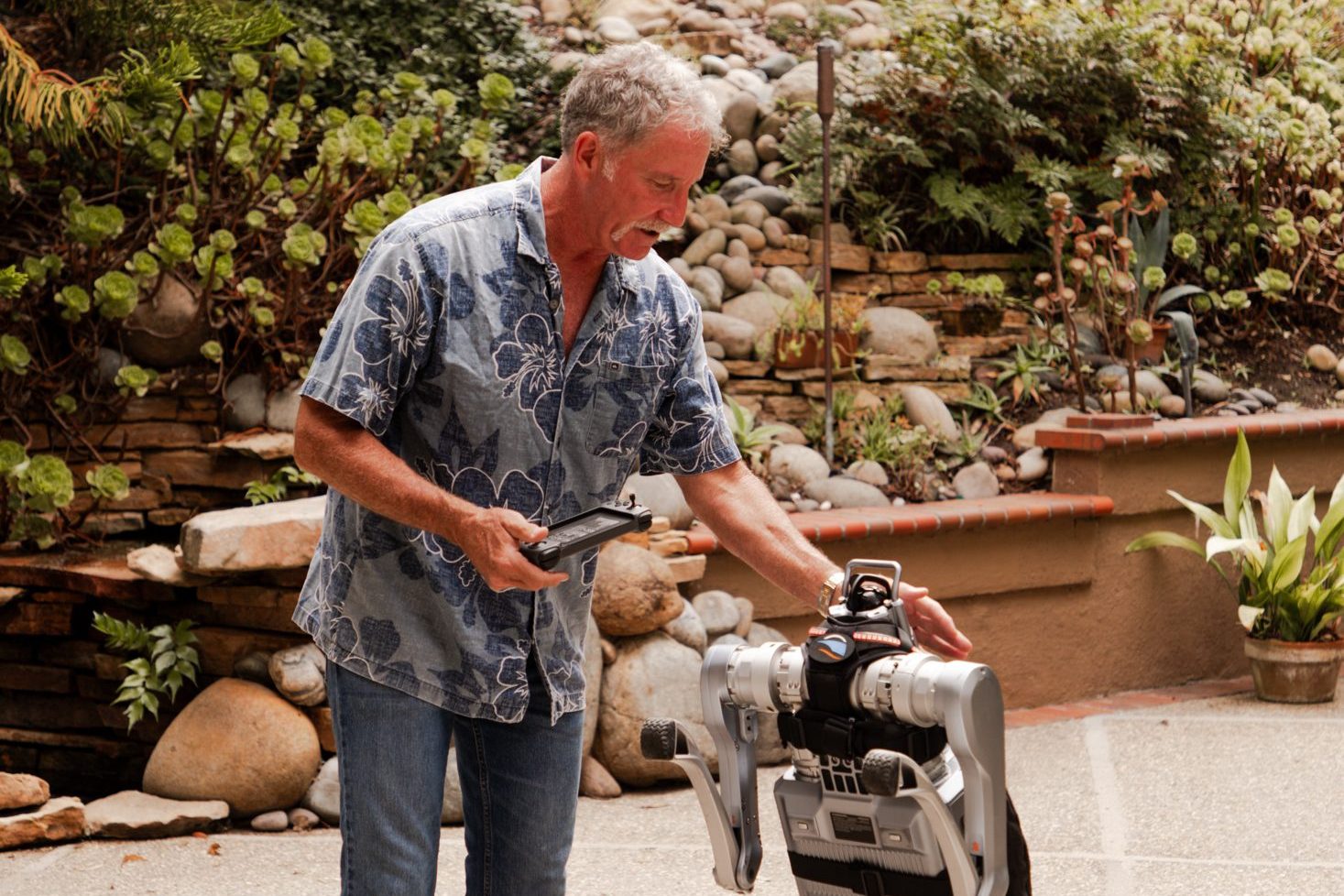
The robotics industry (opens in a new tab) has invested billions of dollars into making machines smarter, pouring money into advanced sensors, artificial-intelligence systems, and machine‑learning models that help robots understand and react to their environments with greater precision. Thanks to AI's extraordinary growth, many robots can now avoid obstacles, recognize objects, optimize their workflows, and make increasingly sophisticated decisions with little or no human intervention.
From a technical standpoint, robotics has made remarkable progress, but technology tells only half the story. The other half of the story relates to human beings.
As robots leave isolated manufacturing settings and begin working alongside people in warehouses, hospitals, airports, retail stores, hotels, public spaces, and even in the home, the greatest challenge is no longer simply building intelligent machines. It's understanding the humans working side-by-side with them.
The future of robotics depends as much on human psychology as it does on artificial intelligence and technology. Successful deployment is no longer just an engineering challenge—it is a human behavior challenge.
Humans Make Emotional Decisions First
While most people believe they make decisions based entirely on logic, behavioral science tells us otherwise. Emotion (opens in a new tab) plays a critical if not equal role. In fact, research shows that even seemingly rational choices are shaped by subconscious emotional cues—experiences, social pressures, and gut instincts that operate long before conscious reasoning kicks in.
Long before we consciously analyze a situation, our brains often perform rapid assessments designed to answer one simple question: "Am I safe?"
Every day we instinctively evaluate our surroundings. When approaching an unfamiliar person, crossing a busy street, or operating machinery, our brains search for visual cues that reduce uncertainty and help us determine how to respond. These split‑second judgments aren't driven by logic alone—they're powered by emotional pattern‑recognition built from experience.
For example:
- When meeting someone new, we immediately scan facial expressions, posture, and tone of voice. A friendly smile lowers our guard; a tense or closed stance triggers caution before we've had time to "think" about why.
- At a busy intersection, the sight of a speeding car or a distracted driver sparks a flash of concern that pulls us back from stepping into the road.
- Even in technical environments, such as when operating machinery, subtle cues—an unusual vibration, a faint burning smell, a warning chime—create a sense of unease that prompts us to stop and reassess.
This process happens almost instantly, and in each case, emotion acts as an early‑warning system, helping us navigate risk long before logic catches up.
The same psychological process occurs when people encounter robots. Before they admire the technology, appreciate the engineering, or consider productivity gains, they instinctively ask themselves: "Is it safe?" "Can I trust it?" "What is it doing?" "What will it do next?" "What data is it accessing?" and "Does it know I'm here?"
These are human questions—not engineering questions—requiring human-centric answers.
The Human Brain Dislikes Uncertainty
Psychologists have long understood that uncertainty creates stress (opens in a new tab). When people cannot predict what will happen next, they naturally become more cautious. This behavior is rooted in survival.
Our brains constantly attempt to reduce ambiguity by gathering information about our environment. But when information is missing, we slow down, we hesitate—seeking additional confirmation before acting.
The same reaction occurs around autonomous machines.
When robotic behavior feels unpredictable or difficult to interpret, people instinctively increase their distance, reduce their confidence, and become more cautious.
The robot may be functioning perfectly, but uncertainty changes human behavior.
Perception Often Matters More Than Reality
People respond to what they perceive, not necessarily to objective reality. Our brains interpret the world through filters shaped by experience and emotion. Two people can witness the same event and walk away with entirely different conclusions.
In practice, perception (opens in a new tab) becomes the "reality" that drives behavior, even when the facts tell a different story.
A robot may satisfy every engineering standard. It may pass every safety inspection. It may perform flawlessly during testing. Yet workers may still feel uncomfortable working alongside it.
Why? Because technical safety and perceived safety are not always the same thing.
Humans trust what they understand. So when machine behavior feels unfamiliar, unclear, or unknowable, perceived risk increases—even when actual risk remains low.
Reducing perceived uncertainty for people when working alongside robots is therefore just as important as reducing technical risk.
Why Familiar Signals Matter
Humans rely heavily on familiar communication systems. Drivers understand brake lights and turn signals. Operators understand machine beacons and alarms. First responders understand siren patterns and color‑coded alerts.
These systems reduce cognitive effort because people already know what the signals mean. No lengthy explanation is required.
Robotics has yet to develop this same level of communication consistency. As a result, interactions between humans and robots require people to interpret unfamiliar machine behavior. This slows confidence, and confidence is what drives acceptance, trust, and adoption.
Cognitive Load and Robotics
Every workplace demands attention:
- Warehouse employees monitor inventory, forklifts, coworkers, and production schedules.
- Healthcare professionals juggle patients, equipment, and constantly changing priorities.
- Manufacturing personnel operate in fast-moving environments where every second matters.
People have limited mental capacity. Psychologists refer to this as cognitive load (opens in a new tab).
The more effort required to interpret a robot's behavior, the less attention people have available for the task itself. Human‑centered robotics should reduce cognitive load, not increase it.
Predictability Builds Trust
People become comfortable around systems that behave consistently:
- Predictability creates familiarity.
- Familiarity builds confidence.
- Confidence creates trust.
This principle applies everywhere.
- Children become comfortable riding bicycles because predictable behavior replaces uncertainty.
- Drivers become confident because traffic follows consistent rules.
- Workers become comfortable around equipment because they understand how it behaves.
Robotics must follow the same pattern. To transform unfamiliar technology into trusted teammates, autonomous machines need to communicate in ways that allow humans to instantly anticipate and trust what happens next—without training, apps, or specialized knowledge.
The Empathy Layer for Robotics™
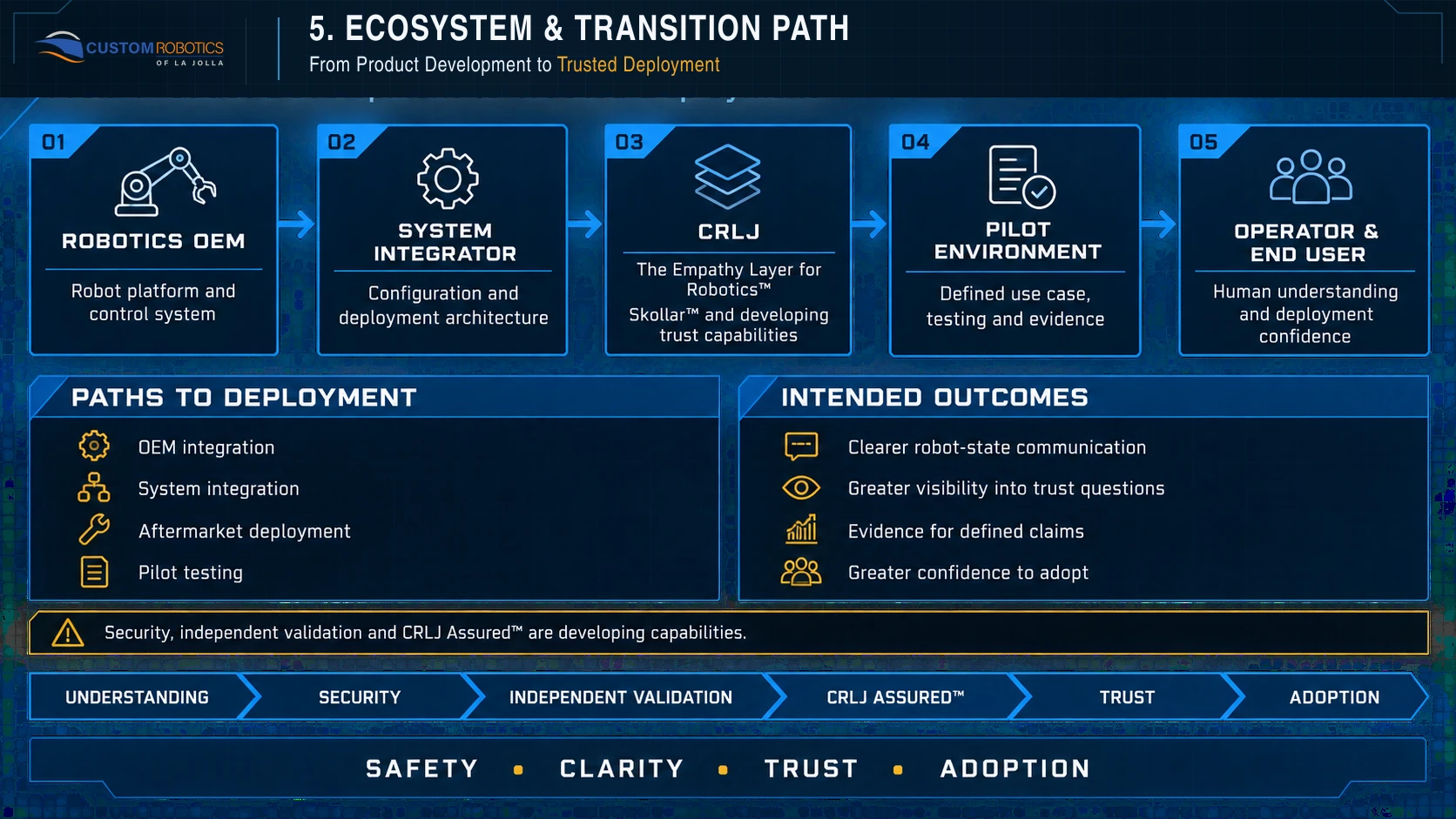
Skillin argues that the robotics industry has overlooked a crucial capability—what he and the Custom Robotics team calls The Empathy Layer for Robotics™. This layer serves as the missing interface between machine intelligence and human trust. Its purpose is simple: translate robotic behavior into clear, human‑readable signals that make autonomous systems instantly understandable.
"Instead of forcing people to decode complex algorithms or unpredictable movements, robots should communicate the way other trusted systems do—through visible, standardized cues that convey intent and status at a glance," he explains.
People should be able to immediately recognize:
- What the robot is doing
- What it intends to do next
- Whether it has detected them
- Whether it is operating normally
- Whether it is safe to approach
When humans can effortlessly interpret and trust a robot's behavior, confidence grows—and confidence is what ultimately accelerates adoption.
Integrating Security, Transparency, and Independent Validation
As robots become more autonomous, communication alone is not enough. People also need to trust how robots handle information, manage data flows, behave, and operate within sensitive environments.
This trust consists of three critical elements:
Security & Data Handling
People want to know what a robot sees, collects, accesses, and transmits—and that its data practices are responsible and secure.
Clear Movement & Intent Communication
Robots must communicate their next action and operational state in ways humans can instantly understand.
Independent Third‑Party Validation
Manufacturers cannot be the sole authority on trust. Neutral, third-party experts must confirm how robots behave, communicate, and manage sensitive information.
Together, these elements build the evidence-based trust organizations need as they deploy robots in shared environments, which is why Custom Robotics is developing CRLJ Assured™, a framework intended to independently validate these practices.
CRLJ Assured™
CRLJ Assured™, currently in development, is intended to independently review and validate a robotics system's behavior, data practices, and status‑ and movement‑intent communication capabilities—with the goal of giving people confidence they can work safely and comfortably alongside them.
Human-Centered Design Creates Better Technology
History shows a consistent pattern: technology succeeds when it adapts to human behavior—not when people are forced to adapt to technology.
Voice assistants didn't take off because speech recognition became technically possible; they succeeded when conversational interfaces began mirroring natural human dialogue. People could speak in everyday language—"set a timer," "play music," "turn off the lights"—and the system responded in a way that felt familiar and effortless.
Digital payments didn't become mainstream because encryption improved; they grew because tap‑to‑pay and mobile wallets removed friction. Instead of navigating complex banking interfaces, people could simply hold a phone near a reader and instantly complete a transaction. Technology adapted to a gesture people already understood.
Robotics is approaching a similar moment. As robots enter workplaces, public spaces, and homes, companies that embrace human psychology will build machines people naturally trust. Those that ignore it may continue producing technically impressive systems—but perceived unpredictability will slow adoption no matter how advanced the underlying technology is.
Looking Ahead: How Custom Robotics Sees It
"Human‑centered design isn't optional in robotics," says Skillin. "It's the foundation for widespread acceptance. The robots that succeed will be the ones that communicate clearly, behave predictably, and align with the way people already perceive and respond to the world around them."
Artificial intelligence will continue transforming robotics. Machine learning will improve. Autonomous systems will become more capable. But technology alone will not determine which companies lead the next generation of robotics. Human psychology will. Because ultimately, robots are not deployed into factories. They are deployed into human environments, and understanding people may become just as important as understanding machines.
Frequently Asked Questions
1. What is the main idea behind the psychology of working alongside robots?
The core idea is that human perception, emotion, and trust strongly influence how comfortable people feel around autonomous machines.
2. Why does perceived safety matter as much as technical safety in robotics?
People respond to what they feel is safe, so unclear or unfamiliar robot behavior can create hesitation even when the machine is functioning perfectly.
3. What is The Empathy Layer for Robotics™?
It is a communication framework designed to translate robotic behavior into clear, human‑readable signals that build trust and reduce uncertainty.
4. How does human‑centered design improve robot adoption?
Human‑centered design makes robots more predictable and intuitive, which increases confidence and accelerates acceptance in real‑world environments.
5. Why is reducing cognitive load important when humans work with robots?
Lower cognitive load allows people to focus on their tasks instead of deciphering robot behavior, making interactions safer and more efficient.
6. What is CRLJ Assured™ and how does it improve human‑robot interaction?
CRLJ Assured™ is Custom Robotics' developing independent assurance framework, intended to verify that a robot handles data responsibly, communicates intent clearly, and operates safely. It is designed to offer third‑party confirmation that the system is understandable and predictable.
Time to Make Your Robots Human‑Ready
If you're looking to bridge the divide between robot autonomy and human acceptance, contact Custom Robotics of La Jolla at info@customrobotics.io to arrange a free, no‑strings‑attached consultation.
About David Skillin
David Skillin is Founder and CEO of Custom Robotics of La Jolla and creator of The Empathy Layer for Robotics™ framework. His work focuses on improving safety, clarity, trust, and adoption in shared human-robot environments.
About Custom Robotics of La Jolla
Custom Robotics of La Jolla (CRLJ) is defining The Empathy Layer for Robotics™—helping humans understand, trust, and safely interact with autonomous systems.