
Why OEMs Shouldn't Build The Empathy Layer for Robotics™
The Case for an Independent Standard That Every Robot Can Speak
Custom Robotics of La Jolla argues that robotic communication should be an independent, universal standard—not defined by OEMs. The Empathy Layer for Robotics™ from Custom Robotics creates clarity, trust, and human-ready operation across diverse autonomous systems.
David Skillin · September 25, 2026
Throughout the history of technology, the most influential standards have rarely been owned by a single manufacturer.
- USB wasn't created for one computer company.
- Bluetooth wasn't built for one smartphone.
- Wi-Fi wasn't designed for one router.
- Seat belts weren't invented by every individual automaker.
Each of these technologies became successful because they were larger than any one company. They created consistency across entire industries, giving consumers confidence regardless of the brand they chose.
"As autonomous systems rapidly enter factories, warehouses, hospitals, airports, hotels, retail environments, and eventually our homes, one question becomes increasingly important, 'Who should define how robots communicate with people?'," explains David Skillin (opens in a new tab), a human-centered robotics strategist, category pioneer, and founder of Custom Robotics of La Jolla (CRLJ). "At Custom Robotics, we believe the answer is clear: it shouldn't be the OEMs alone. It should evolve as an independent, universal standard (opens in a new tab)—one that serves people first and manufacturers second."
The Fragmentation Problem
Today's robotics industry is highly innovative. Every manufacturer is solving difficult engineering challenges in unique ways they hope will give them a competitive advantage:
- Different navigation systems.
- Different AI models.
- Different sensors.
- Different hardware.
It's the kind of diversity that fuels innovation, but when it comes to communication with humans, diversity can become a liability.
Picture a warehouse environment where:
- One robot flashes blue.
- Another flashes green.
- One uses sounds.
- Another displays text.
- A third communicates almost nothing.
For workers, so much inconsistency creates confusion. They shouldn't need to learn a different "language" for every robot they encounter.
Trust Requires Neutrality
People naturally place greater trust in independent standards than in proprietary claims.
Consider familiar examples:
- UL Certification
- Energy Star
- Wi-Fi Certified
- Bluetooth
- USB
- ISO Standards
These types of certification programs succeed because they aren't perceived as marketing. They represented independent verification and common expectations. The same opportunity exists for robotics.
Rather than allowing each OEM to define its own communication philosophy, the industry can benefit from an independent framework that establishes consistent expectations for human interaction.
CRLJ Assured™
Guided by the four pillars of Safety, Clarity, Trust, and Adoption, Custom Robotics has pioneered CRLJ Assured™—an independent validation mark organizations can rely on to confirm that a robot meets defined standards for communication, transparency, responsible data practices, monitoring, and human ready operation in diverse environments.
CRLJ Assured™ provides third-party validation of how a robot communicates, behaves, and manages the information it relies on, offering evidence-based assurance that goes beyond manufacturer claims and strengthens public trust.
Why This Matters for OEMs
At first glance, manufacturers might view standardization as a limitation. Custom Robotics believes it creates opportunity. We believe standardization can expand markets rather than restrict innovation.
A common communication layer such as The Empathy Layer for Robotics™, together with common third-party validation, would allow OEMs to focus on what they do best: building exceptional robots.
Instead of investing resources into developing proprietary communication systems, manufacturers could adopt a recognized framework that customers already understand and trust. This would reduce friction during deployment, accelerate customer acceptance, and help robotics scale more quickly across industries.
The Empathy Layer for Robotics™
At Custom Robotics, we define The Empathy Layer for Robotics™ as the communication framework that translates robotic intelligence, behavior, and intent into intuitive human understanding. Its purpose is not to control robots; it is to help people understand them.
The Empathy Layer for Robotics™ communicates several fundamental categories of information:
- Intent
- Operational state
- Awareness of nearby humans
- Data collection, processing, and storage statuses
- Hazard or fault conditions
These signals should be recognizable regardless of who built the robot, much in the same way every driver recognizes brake lights regardless of the vehicle manufacturer.
Introducing Skollar™
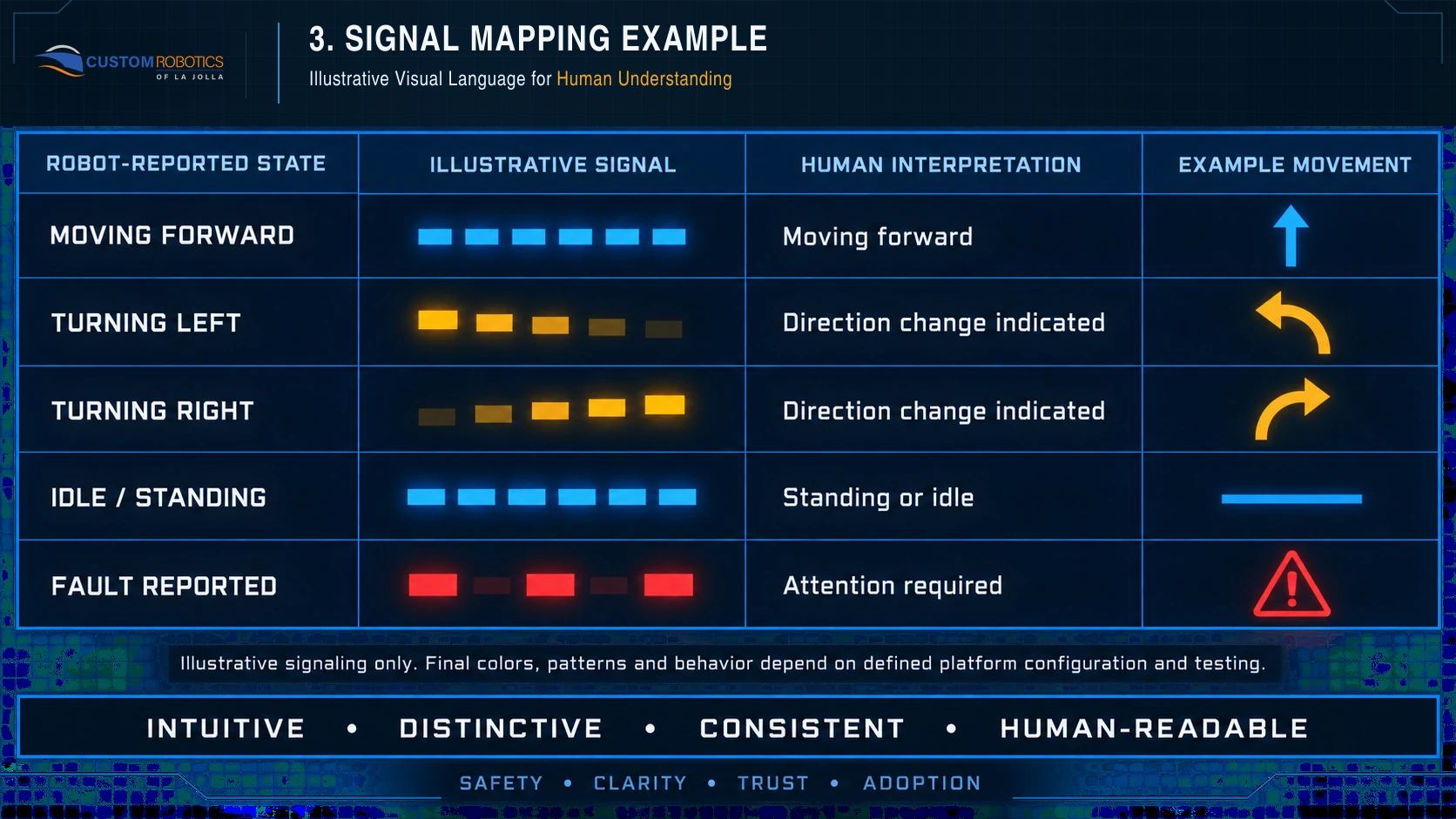
Skollar™ is the first physical implementation of The Empathy Layer for Robotics™, giving robots a persistent, human-readable signaling interface that works independently of dashboards or cloud connectivity. This hardware provides a simple, intuitive, and physical way for people to understand machine behavior in real time.
Its human-centered signaling model converts machine states—standby, forward movement, turning, reversing, docking, low power, faults, or emergency conditions—into clear visual patterns that can be interpreted in under two seconds.
The "Intel Inside" Opportunity
One of the most successful branding strategies in technology history was "Intel Inside." Consumers didn't buy computers because they understood semiconductor architecture, they bought confidence. They came to know that the Intel Inside mark represented reliability, quality, and trust.
Robotics can eventually achieve a similar universally recognized assurance layer.
Organizations deploying autonomous systems will increasingly ask:
- Does this robot communicate effectively?
- Does it meet recognized human interaction standards?
- Has it been independently evaluated?
- What information is it collecting and how is it storing data?
- Is it ready to operate safely around people?
These questions create an opportunity for an independent empathy layer certification that signals confidence before a robot is ever deployed.
Looking Ahead: Building an Industry, Not Just a Product
The most influential companies don't simply create products. They create categories.
The Empathy Layer for Robotics™ from Custom Robotics represents more than a product feature. It represents an entirely new layer of robotics infrastructure—one that complements artificial intelligence rather than competing with it.
The robotics industry is entering a period of extraordinary growth. With that growth comes an opportunity—and a responsibility. The industry can either develop dozens of competing communication systems, or it can establish a common language that benefits everyone.
OEMs will continue competing on performance, capability, speed, and innovation. The Empathy Layer for Robotics™ ensures those innovations can be understood and trusted by the people they serve.
Frequently Asked Questions
1. What is The Empathy Layer for Robotics™?
The Empathy Layer for Robotics™ is a human-centric communication framework developed by Dave Skillin and Custom Robotics of La Jolla that translates a robot's internal status, data-handling and security posture, and intent into clear, intuitive signals people can understand instantly.
2. Why shouldn't OEMs define robotic communication standards on their own?
OEM-specific communication creates fragmentation, forcing people to learn different signals for every robot. An independent standard ensures consistency, clarity, and confidence across the entire industry.
3. How does an independent Empathy Layer benefit manufacturers?
A universal communication framework lets OEMs focus on innovation—navigation, sensors, AI, and mobility—while relying on a shared standard that customers already understand and trust.
4. What problem does inconsistent robot communication create for workers?
Inconsistent signals—different lights, sounds, screens, or no communication at all—increase cognitive load and hesitation, making shared environments less intuitive and less safe.
5. What is Skollar™?
Skollar™ is Custom Robotics' first physical implementation of The Empathy Layer for Robotics™, giving robots a human-readable signaling interface that works without dashboards or cloud access. This hardware's decentralized edge architecture ensures low-latency, offline-safe, redundant operation even during connectivity loss. Skollar™ turns machine states into intuitive visual cues people can interpret in under two seconds.
6. Why is neutrality essential for building trust in autonomous systems?
People trust independent standards more than proprietary claims, and third-party validation provides evidence-based assurance that a robot communicates clearly, behaves predictably, and manages data responsibly.
7. What is CRLJ Assured™ and how does it improve human-robot interaction?
CRLJ Assured™ is Custom Robotics' developing independent assurance framework, intended to verify that a robot handles data responsibly, communicates intent clearly, and operates safely. It is designed to offer third-party confirmation that the system is understandable and predictable.
Time to Make Your Robots Human-Ready
If you're looking to bridge the divide between robot autonomy and human acceptance, contact Custom Robotics of La Jolla at info@customrobotics.io to arrange a free, no-strings-attached consultation.
About David Skillin
David Skillin is Founder and CEO of Custom Robotics of La Jolla and creator of The Empathy Layer for Robotics™ framework. His work focuses on improving safety, clarity, trust, and adoption in shared human-robot environments.
About Custom Robotics of La Jolla
Custom Robotics of La Jolla (CRLJ) is defining The Empathy Layer for Robotics™—helping humans understand, trust, and safely interact with autonomous systems.