
Why Robotics Adoption Is Broken
The Hidden Human Barrier Slowing the Future of Automation
Robotics adoption fails not from lack of intelligence but from lack of human understanding—an insight Custom Robotics of La Jolla believes will define the next era of automation as organizations seek clarity, trust, and true human‑readiness.
David Skillin · June 10, 2026
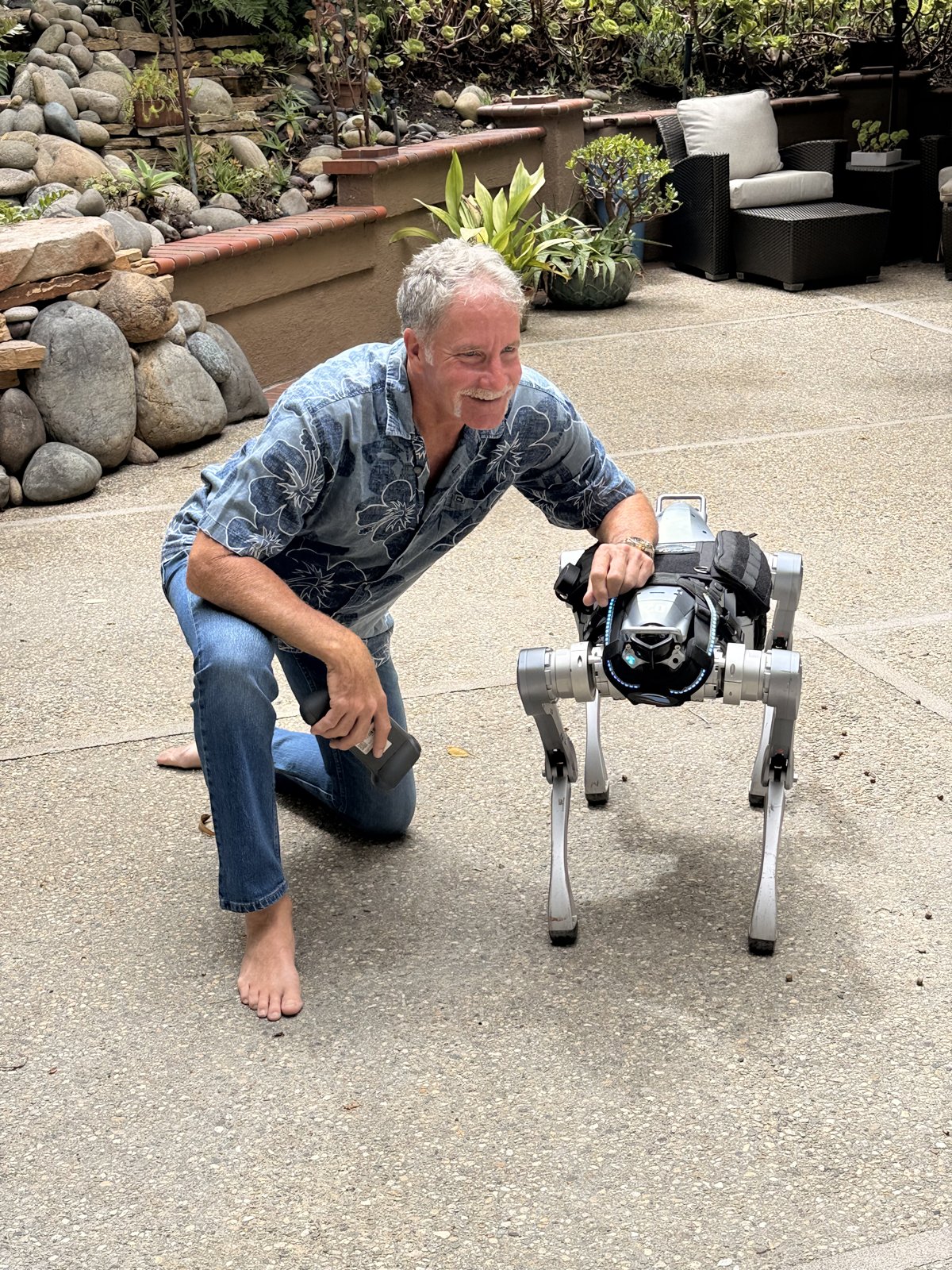
The robotics industry has never been more advanced.
- Autonomous mobile robots navigate warehouses without human guidance.
- Collaborative robots work alongside employees on manufacturing floors.
- Artificial intelligence enables machines to make decisions, optimize workflows, and adapt to changing conditions in real time.
In fact, according to the International Federation of Robotics (opens in a new tab) (IFR), global robot installations continue to grow as organizations face labor shortages, rising operational costs, and increasing pressure to improve efficiency.
Yet despite this momentum, many robotics deployments still struggle to scale.
- Projects that perform exceptionally well in pilot programs often encounter resistance when expanded across facilities.
- Organizations invest heavily in robotics platforms only to discover that adoption is slower than anticipated.
- Workers remain hesitant.
- Safety teams ask difficult questions.
- Managers encounter operational friction they never expected.
Why?
"Robotics deployment does not fail at intelligence—it fails at human understanding and communication," explains David Skillin, Founder and CEO of Custom Robotics of La Jolla (CRLJ). It's the conclusion he has reached after decades working in safety-critical environments and studying how humans interact with complex systems. "The robotics industry has spent years making machines smarter. But very few people are asking how we make robots easier for humans to understand. That's where the next major opportunity exists."
The Industry's Blind Spot
Most robotics innovation focuses on what robots can do. The conversation usually revolves around:
- Artificial Intelligence
- Machine Learning
- Computer Vision
- Sensor Technology
- Navigation Systems
- Automation Efficiency
These are all important advancements, but there is another question the industry rarely asks:
How do humans know what a robot is doing or going to do?
Imagine robots and people working side-by-side in a warehouse. A robot may know whether it is about to stop, reverse, turn, or enter a fault condition, but the worker standing beside it often does not.
This communication gap creates uncertainty, and uncertainty creates resistance.
The Difference Between Safety and Perceived Safety
One of the most misunderstood concepts in robotics deployment is the difference between actual safety and perceived safety.
A robotics system may meet every technical safety requirement.
- It may pass every inspection.
- It may satisfy every engineering specification.
- Yet workers can still feel uncomfortable around it.
Why?
Because humans evaluate risk differently than machines. People constantly assess their environment through visual signals and behavioral cues. We do this instinctively.
When driving, we rely on:
- Brake lights
- Turn signals
- Traffic lights
- Hazard indicators
In aviation, pilots rely on standardized warning systems. In healthcare, clinicians depend on monitors, alarms, and visual indicators to quickly assess patient status.
These communication systems exist because human beings require immediate situational awareness.
Robotics has not yet developed a comparable communication standard. As a result, workers are often asked to trust machines they cannot easily read.
Why Dashboards Are Not the Answer
Many robotics companies attempt to solve their communication challenges through software.
- Dashboards provide valuable operational data.
- Control systems provide oversight.
- Analytics platforms cover important indicators.
But none of these tools solve the immediate communication problem occurring on the warehouse floor. Workers need immediate understanding. They do not carry dashboards around with them, they do not constantly monitor screens, and they don't have time to do so.
In real-world environments, decisions are often made within seconds. People need to know:
- Is the robot operating normally?
- Is it stopping?
- Is it turning?
- Is it reversing?
- Has it detected me?
- Is it experiencing a fault?
The Adoption Gap
At CRLJ, we refer to this challenge as the Adoption Gap. The Adoption Gap exists between machine intelligence and human confidence.
Organizations frequently assume that if a robot works technically, adoption will naturally follow. Reality is more complicated.
Successful adoption depends on four interconnected outcomes:
- Safety: People must believe they can safely operate around the machine.
- Clarity: People must understand what the machine is doing.
- Trust: Understanding creates confidence.
- Adoption: Confidence drives acceptance and scale.
This progression is simple: Safety → Clarity → Trust → Adoption
Break any link in the chain and adoption slows; strengthen all four and deployment accelerates.
The Missing Layer in Robotics
This challenge has led CRLJ to conclude that the robotics industry is missing an entire category. Computers evolved dramatically when graphical user interfaces made technology accessible to everyday users; the internet scaled because browsers simplified complexity; and automobiles became safer because communication standards became universal.
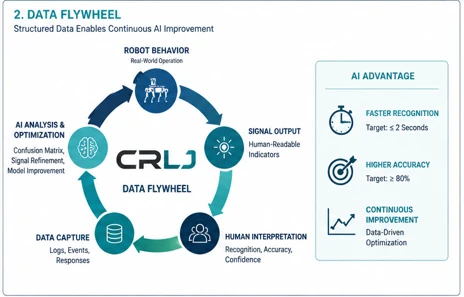
Now robotics is facing a similar moment. The next major advancement may not be another AI breakthrough, but the emergence of what we call The Empathy Layer for Robotics™. This layer serves as the bridge between machine intelligence and human understanding. Its purpose is to translate robotic behavior, status, and intent into human-readable communication.
Not for engineers. Not for programmers. But for the people who work alongside robots every day.
Why This Matters Now
Robotics is expanding rapidly into:
- Warehousing
- Manufacturing
- Healthcare
- Logistics
- Hospitality
- Retail
- Public environments
At the same time, regulators, insurers, employers, and workers are asking increasingly difficult questions about safety, accountability, and transparency.
The robotics industry is entering a new phase. Where the first phase of robotics focused on capability, and the second focused on intelligence, the next phase will focus on understanding.
Organizations that recognize this shift early will be better positioned to deploy, scale, and integrate robotics successfully.
Time to Make Your Robots Human‑Ready
If you're looking to bridge the divide between robot autonomy and human acceptance, contact Custom Robotics of La Jolla at info@customrobotics.io to arrange a free, no‑strings‑attached consult.
About David Skillin
David Skillin is Founder and CEO of Custom Robotics of La Jolla and creator of The Empathy Layer for Robotics™ framework. His work focuses on improving safety, clarity, trust, and adoption in shared human-robot environments.
About Custom Robotics of La Jolla
Custom Robotics of La Jolla (CRLJ) is defining The Empathy Layer for Robotics™—helping humans understand, trust, and safely interact with autonomous systems.