
Why Human Understanding May Become the Next Robotics Standard
The Missing Requirement That Could Define the Future of Automation
As autonomous systems move into shared environments, Custom Robotics of La Jolla believes that human understanding will become a defining standard of success in deploying and scaling robotics.
David Skillin · June 10, 2026
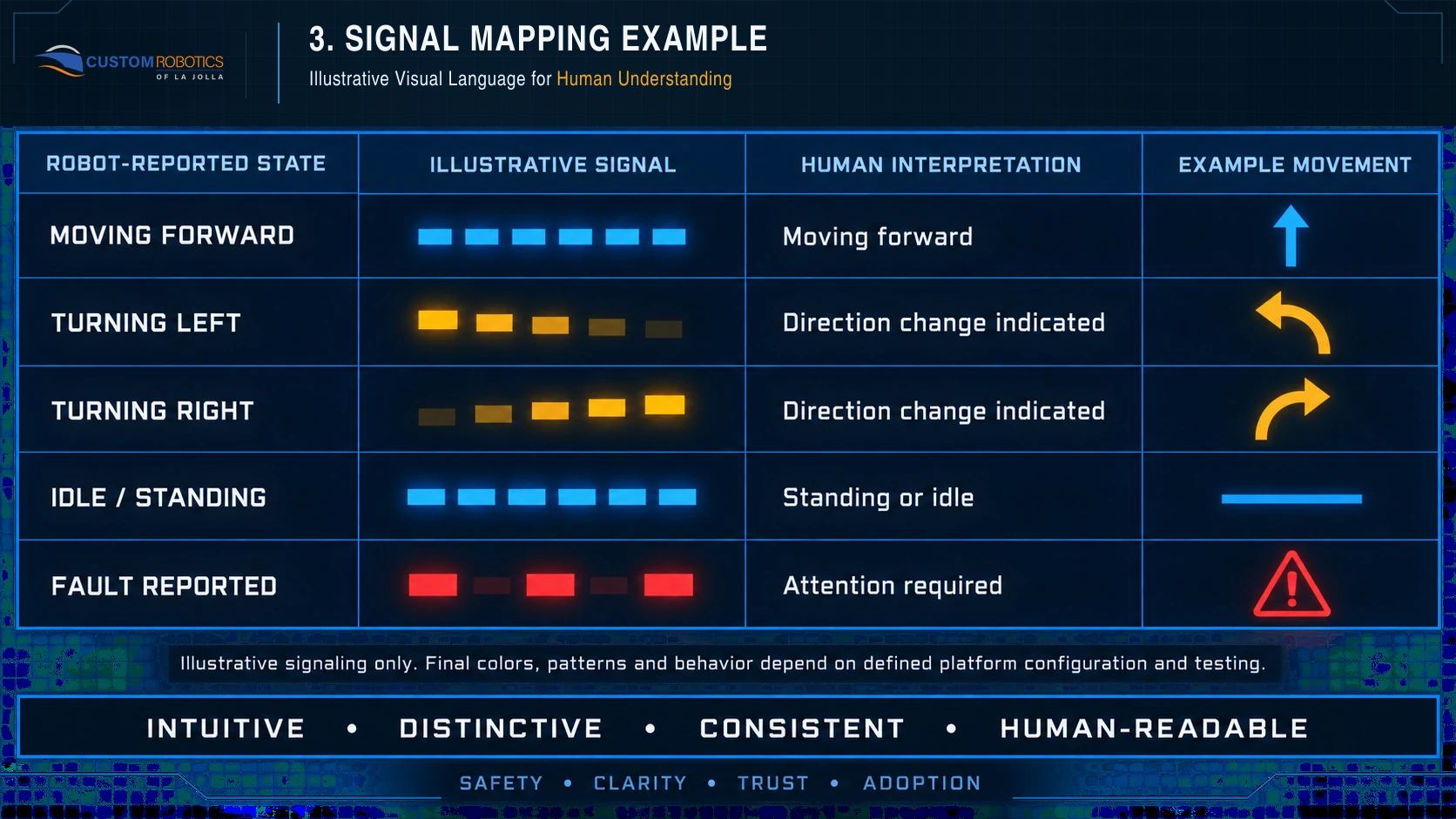
The robotics industry has standards for safety, standards for performance, standards for interoperability, reliability, and testing.
There is, however, one area where the industry still lacks a universally accepted framework: human understanding.
As robots become more autonomous and increasingly common in shared human environments, organizations are beginning to recognize that it's not for robots to understand the world around them. Humans must also understand the robots.
Custom Robotics of La Jolla (CRLJ) believes human understanding may become one of the most important standards in the future of robotics—not because regulators demand it, but because successful adoption depends on it.
The Evolution of Robotics Standards
Throughout history, industries have developed standards as technology became widely adopted.
The automobile industry introduced standards for:
- Brake lights
- Turn signals
- Traffic signs
- Safety systems
Aviation developed standards for:
- Cockpit instrumentation
- Warning systems
- Flight procedures
- Communication protocols
Healthcare adopted standards for:
- Vital signs
- Alarm systems
- Patient monitoring
- Safety procedures
These standards emerged because as systems became more sophisticated, people needed consistent ways to understand them. Robotics is approaching a similar moment.
We are no longer asking "Can robots perform the work?" but wondering "Can humans understand what the robots are doing?"
The Rise of Shared Human-Robot Environments
For many years, robots operated largely in isolation. Industrial robots were placed behind safety barriers and separated from human workers. Interaction was limited, so communication was less important.
Today's robots are dramatically different. The International Federation of Robotics (opens in a new tab) (IFR) reports that robotics deployments continue to expand into environments where humans and machines work side by side.
Imagine encountering a robot moving through a busy warehouse. You may immediately ask:
- Is it stopping?
- Is it turning?
- Has it detected me?
- Is it aware of my presence?
- Is it operating normally?
- Is it safe to approach?
As robots move closer to people, real-time, visual communication becomes increasingly important.
The Hidden Cost of Ambiguity
Humans constantly assess risk and intent. It's called situational awareness. The challenge is that many robotics systems do not communicate these answers clearly.
The robot knows exactly what it is doing and where it is going, but nearby workers frequently do not. This creates ambiguity, and ambiguity creates consequences.
Organizations may experience:
- Slower adoption
- Workforce resistance
- Increased training requirements
- Operational hesitation
- Reduced trust
- Safety concerns
The challenge is not necessarily technical capability. The challenge is human understanding.
"The robotics industry has become exceptionally good at teaching machines how to understand their environments," explains CRLJ Founder and CEO David Skillin (opens in a new tab). "We now need to teach machines how to communicate that understanding back to humans."
That communication gap may represent one of the largest opportunities in robotics today.
Understanding Creates Trust
Human beings trust systems they understand. This principle applies across virtually every industry.
- Drivers trust transportation systems because they understand signals.
- Pilots trust aircraft because information is clearly communicated.
- Healthcare professionals trust monitoring systems because critical information is visible and standardized.
Robotics has not yet achieved this level of communication consistency. As a result, trust is developing more slowly. The Association for Advancing Automation (opens in a new tab) (A3) reports that workforce acceptance and organizational readiness remain vital to the deployment of successful automation initiatives.
Trust influences:
- Adoption speed
- Deployment success
- Workforce acceptance
- Safety confidence
- Long-term scalability
Without trust, adoption slows. With trust, organizations move forward.
The Empathy Layer for Robotics™
CRLJ believes the robotics industry is missing a foundational element, something we call The Empathy Layer for Robotics™. It serves as the bridge between machine intelligence and human understanding, translating robotic behavior into intuitive, human-readable communication.
The goal is to help humans quickly understand:
- Status
- Intent
- Direction
- Awareness
- Safety conditions
- Operational states
This concept is similar to how graphical user interfaces accelerated mass adoption of personal computers and smartphones when technology became easier to understand.
Robotics may be approaching a similar inflection point.
Could Human Understanding Become a Standard?
The question is no longer whether communication matters. The question is whether communication eventually becomes expected. History suggests that it will.
As technologies mature, industries tend to standardize around the practices that improve safety, usability, and adoption. Human-readable communication systems support all three.
Future robotics standards may eventually address:
- Intent communication
- Status visibility
- Human awareness indicators
- Operational transparency
- Shared-environment interaction
While the specifics remain uncertain, the direction seems increasingly clear.
The future of robotics will require greater emphasis on human understanding.
Looking Ahead
The robotics industry is entering a new phase. The first era focused on automation. The second focused on intelligence. The next era will focus on understanding.
Organizations that embrace this shift early will gain significant advantages. They will build systems that are not only capable, intelligent, and autonomous, but approachable, understandable, and human-ready.
Ultimately, the future of robotics will not be determined solely by what machines can do.
It will be determined by how effectively humans can understand and work with them.
Time to Make Your Robots Human‑Ready
If you're looking to bridge the divide between robot autonomy and human acceptance, contact Custom Robotics of La Jolla at info@customrobotics.io to arrange a free, no‑strings‑attached consult.
About David Skillin
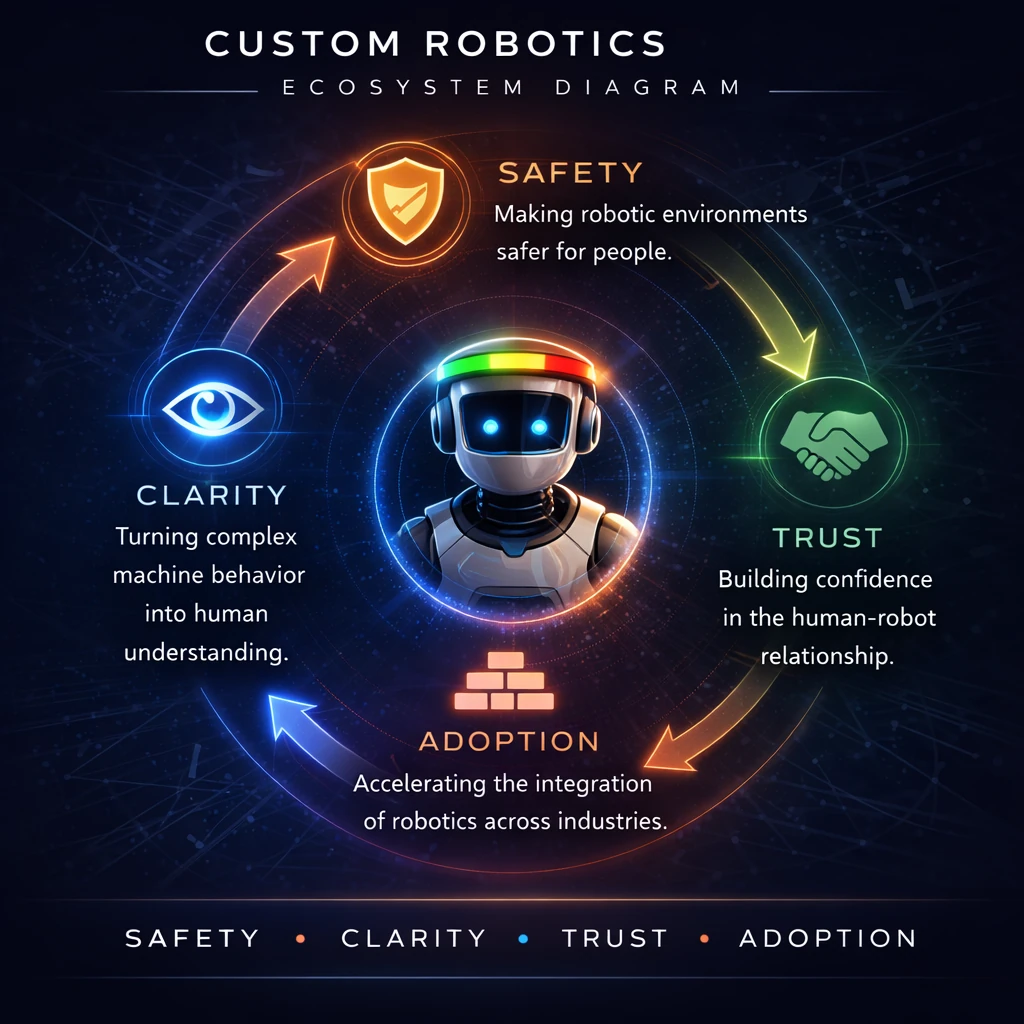
David Skillin is Founder and CEO of Custom Robotics of La Jolla and creator of The Empathy Layer for Robotics™ framework. His work focuses on improving safety, clarity, trust, and adoption in shared human-robot environments.
About Custom Robotics of La Jolla
Custom Robotics of La Jolla (CRLJ) is defining The Empathy Layer for Robotics™—helping humans understand, trust, and safely interact with autonomous systems.