
Bridging the Cognitive Gap in Human-Robot Interaction
Establishing The Empathy Layer for Robotics™ Through Human-Readable Telemetry and Intent Broadcasting
David Skillin · June 10, 2026
Loading form…
Alternatively, email info@customrobotics.io.
What a Decision-Maker Should Retain.
- Robotics adoption may be constrained not by intelligence limitations, but by communication limitations.
- Cognitive Translation Cost is the mental effort required to interpret robot behavior through indirect observation.
- The proposed study combines hardware engineering, cognitive psychology, human factors research and empirical evaluation.
- Target benchmarks include ≤ 2-second state recognition and ≥ 80% interpretation accuracy.
- Potential impact spans public safety, workforce readiness, accessibility, standardization and economic acceleration.
The Full Paper.
Robotics research has traditionally focused on enabling machines to better perceive, interpret, and respond to human behavior. Significant advances have been achieved in computer vision, natural language processing, sensor fusion, reinforcement learning, and embodied artificial intelligence. However, comparatively little attention has been devoted to the inverse challenge: enabling humans to rapidly and intuitively understand the operational state and intent of autonomous systems.
As robots increasingly enter shared human environments—including warehouses, manufacturing facilities, hospitals, municipalities, and public infrastructure—the inability of nearby humans to interpret machine intent creates cognitive burden, operational hesitation, safety concerns, and adoption resistance.
This research concept paper proposes a new Human-Robot Interaction framework centered on the concept of The Empathy Layer for Robotics™. The proposed framework introduces localized, edge-computed visual telemetry capable of translating robotic operational states into instantly recognizable human-readable signals.
The research seeks to investigate whether deterministic visual signaling systems can reduce cognitive load, improve trust, accelerate decision-making, and improve overall human-machine collaboration.
The proposed study would combine hardware engineering, cognitive psychology, human factors research, and empirical evaluation to help establish measurable criteria for robotic intent communication and human-readable autonomy.
1. Introduction
The next generation of robotics adoption will not be determined solely by advances in machine intelligence. It will be determined by human understanding.
Robots are rapidly transitioning from isolated industrial environments into shared spaces where humans and autonomous systems must work together. These environments include:
- Warehouses
- Logistics facilities
- Manufacturing floors
- Healthcare environments
- Municipal operations
- Educational settings
- Public infrastructure
While robotics systems have become increasingly capable of understanding humans and their environments, humans remain largely unable to interpret the internal states and decision-making processes of robots.
This creates a significant communication imbalance.
Humans frequently cannot determine:
- What a robot is doing
- What a robot intends to do next
- Whether it is safe to approach
- Whether the system is operating normally
- Whether intervention is required
This lack of visibility introduces uncertainty and increases cognitive demand.
The central premise of this research is that robotics adoption may be constrained not by intelligence limitations, but by communication limitations.
2. Background and Literature Review
2.1 Human-Robot Interaction Evolution
Human-Robot Interaction research has traditionally focused on:
- Human command interpretation
- Social robotics
- Human intention recognition
- Natural language interfaces
- Gesture recognition
- Explainable artificial intelligence
While these advances improve robot understanding of humans, fewer studies have examined human understanding of robots. Most robotic systems remain opaque from the perspective of nearby humans.
Humans are often forced to infer intent through:
- Motion observation
- Dashboard monitoring
- Contextual assumptions
- Prior experience
This process creates what this paper defines as “Cognitive Translation Cost.”
2.2 Cognitive Translation Cost
Cognitive Translation Cost refers to the mental effort required for a human to interpret robotic behavior through indirect observation rather than direct communication. Examples include:
- Determining whether a robot intends to stop or continue moving
- Identifying whether a system is experiencing a fault condition
- Understanding whether a robot is operating autonomously or awaiting instruction
As system complexity increases, this translation burden increases as well.
3. Research Problem Statement
Current robotics platforms lack a universal, platform-agnostic communication framework that enables humans to instantly understand machine intent.
The absence of such a framework contributes to:
- Operational hesitation
- Reduced trust
- Increased perceived risk
- Worker resistance
- Slower deployment
- Reduced adoption
This research seeks to determine whether human-readable signaling systems can measurably improve human understanding and collaboration with autonomous systems.
4. Research Hypothesis
4.1 Primary Hypothesis
Humans interacting with robots equipped with visible, deterministic intent-signaling systems will demonstrate the following when compared to interactions involving robots lacking such communication systems:
- Faster state recognition
- Higher interpretation accuracy
- Reduced cognitive load
- Increased trust
- Improved operational confidence
4.2 Secondary Hypothesis
Human-readable robotic telemetry may function as a leading indicator of robotics adoption readiness across operational environments.
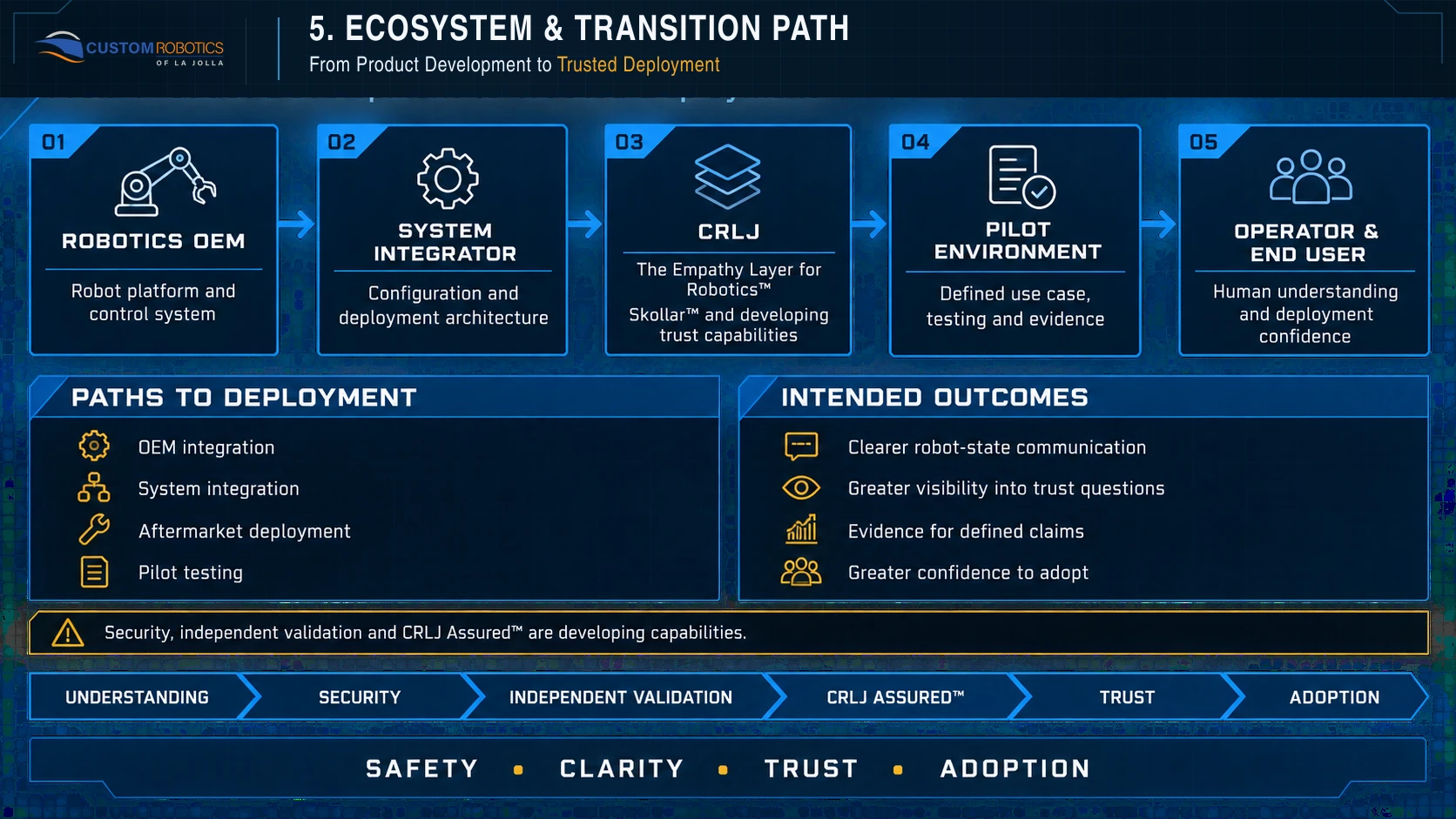
5. Proposed Framework: The Empathy Layer for Robotics™
CRLJ defines The Empathy Layer for Robotics™ as: “A platform-agnostic communication framework that translates robotic behavior, operational state, and intent into instantly understandable human-readable signals.”
The framework operates independently of:
- AI decision systems
- Cloud infrastructure
- OEM software platforms
- Fleet management systems
Instead, it focuses exclusively on human understanding. Core design principles include:
- Visibility
- Consistency
- Deterministic communication
- Peripheral recognition
- Low cognitive demand
- Platform independence
6. Technical Architecture
The proposed system utilizes localized edge processing through embedded microcontroller architecture. Key characteristics include:
- Local state interpretation
- Deterministic signaling logic
- Offline-capable operation
- Low-latency response
- Minimal computational overhead
Operational states may include:
- Idle
- Forward movement
- Turning
- Reversing
- Fault condition
- Emergency stop
- Docking mode
Each state is associated with a unique visual communication pattern designed for rapid human interpretation.
7. Research Methodology
7.1 Experimental Design
The proposed research would use a mixed-methods approach combining:
- Hardware engineering
- Human factors testing
- Cognitive psychology
- Behavioral observation
7.2 Participants
Proposed participant groups include:
- Warehouse personnel
- Manufacturing workers
- Non-robotics participants
- Safety professionals
- Members of the general public
7.3 Testing Environments
Proposed test environments would simulate:
- Shared workspaces
- Warehouse intersections
- Human crossing zones
- Robot approach scenarios
- Emergency stop events
8. Data Collection
Measurements will include the following.
Recognition Speed
- Time required for participants to identify robotic state
Interpretation Accuracy
- Percentage of correctly identified operational states
Cognitive Load
- Measured using validated cognitive workload assessment frameworks
Trust Metrics
- Participant confidence and willingness-to-interact scores
Physiological Measures
Potential metrics include:
- Eye tracking
- Reaction time analysis
- Galvanic skin response
- Behavioral observation
9. Expected Outcomes
The research anticipates measurable improvements in:
- Human comprehension speed
- State interpretation accuracy
- Situational awareness
- Trust and confidence
- Operational efficiency
Target benchmarks include:
- ≤ 2-second state recognition
- ≥ 80% interpretation accuracy
- Reduced hesitation behavior
- Improved worker confidence ratings
10. Potential Broader Impact
The potential impact extends beyond robotics research, including:
- Public Safety: Improved human understanding of autonomous systems operating in shared environments.
- Workforce Readiness: Reduced resistance to robotics deployment through increased transparency.
- Accessibility: More intuitive interactions between humans and autonomous technologies.
- Standardization: Foundational research supporting future robotics communication standards.
- Economic Impact: Acceleration of robotics adoption through improved trust and usability.
11. Future Research Opportunities
Future investigations may include:
- Multimodal communication systems
- Haptic signaling
- Audio signaling frameworks
- Human emotional response analysis
- Standardized robotics signaling protocols
- Cross-cultural interpretation studies
Conclusion
The robotics industry has spent decades teaching machines to understand humans. The next challenge is teaching robots how to communicate with humans.
As robotics systems become increasingly autonomous, human understanding becomes a critical component of safety, trust, and adoption. This research proposes The Empathy Layer for Robotics™ as a foundational framework for human-readable autonomy.
By reducing cognitive translation costs and improving intent visibility, the proposed research seeks to establish new principles for human-machine collaboration and contribute to a future in which autonomous systems are not merely intelligent, but understandable.