
Decentralized Visual Telemetry for Extravehicular Human-Machine Teaming
Establishing Human-Readable Autonomy for Lunar Surface Operations, Deep-Space Exploration, and Autonomous Mission Support
David Skillin · June 10, 2026
Loading form…
Alternatively, email info@customrobotics.io.
What a Decision-Maker Should Retain.
- Astronauts cannot continuously divert attention to secondary telemetry systems during EVA operations.
- State Opacity becomes a mission risk where visibility, attention and communications are constrained.
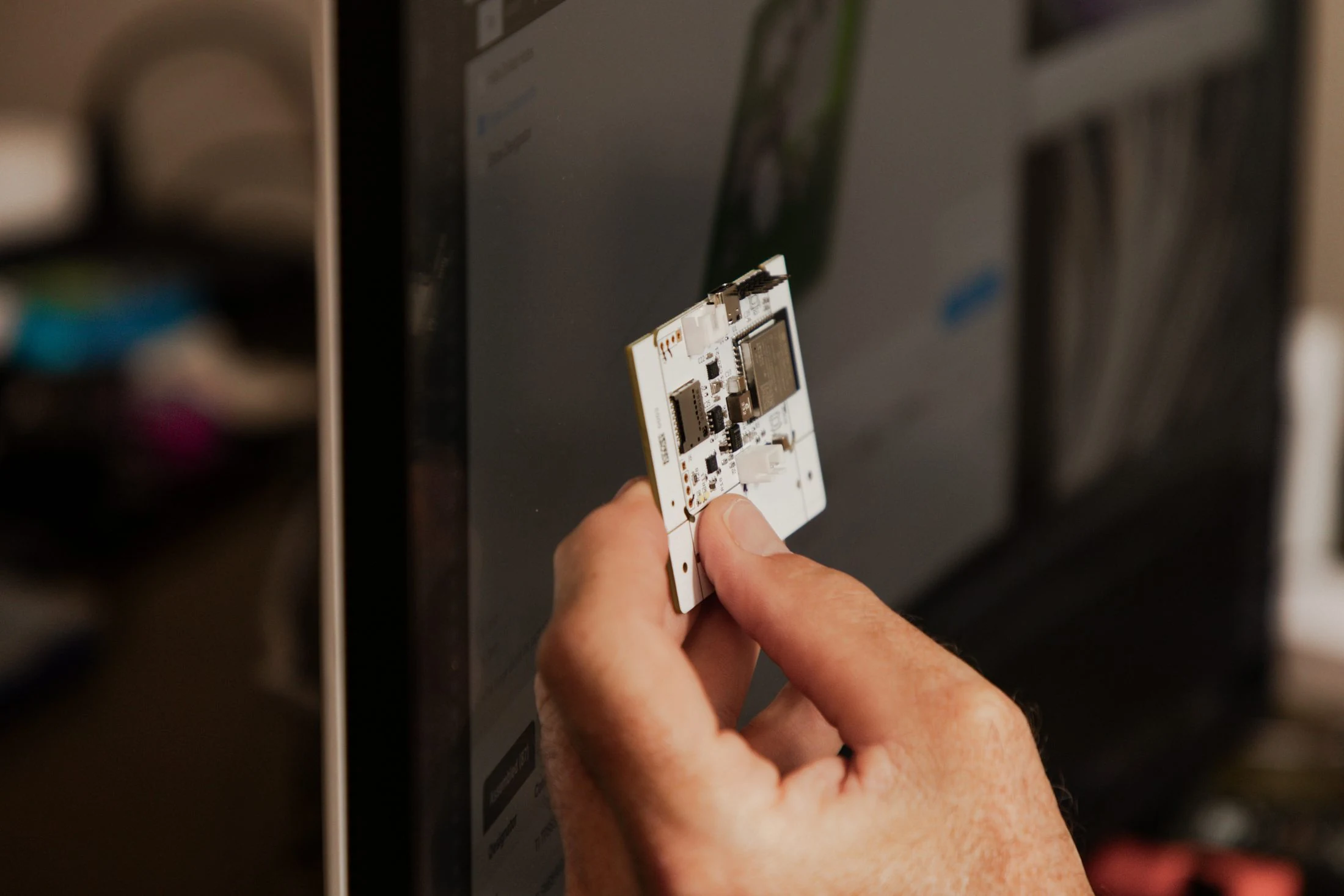
- Skollar™ is designed to use decentralized edge processing for low-latency, offline-capable, deterministic signaling.
- A space-oriented implementation would need to meet strict Size, Weight and Power (SWaP) constraints.
- Localized visual signaling is intended to add communications redundancy and mission resilience.
The Full Paper.
Future lunar missions, deep-space exploration initiatives, orbital infrastructure projects, and autonomous habitat operations will increasingly rely upon close collaboration between astronauts and autonomous robotic systems.
Public space-exploration plans, including NASA's stated goal of sustained human presence beyond Earth, anticipate robots capable of performing logistics, maintenance, inspection, transportation, construction, hazard detection, and mission support activities alongside human crews.
While robotics capabilities continue to advance rapidly, one critical challenge remains unresolved: humans often cannot instantly understand the operational state, intent, or readiness of nearby autonomous systems. Unlike with another person—where we instinctively read facial expressions, tone, and body language—robots offer few natural cues for humans to interpret.
This challenge becomes significantly more consequential in extraterrestrial environments where:
- Human attention is limited
- Visibility is constrained
- Environmental hazards are elevated
- Communications may be delayed or disrupted
- Mission failure carries significant consequences
Traditional telemetry systems rely heavily upon dashboards, diagnostic interfaces, mission control systems, and network-based communication architectures. These approaches provide data but do not necessarily provide understanding.
Astronauts conducting Extravehicular Activities (EVAs) cannot continuously divert attention toward secondary telemetry systems while simultaneously managing navigation, safety, tools, mission objectives, and environmental hazards.
The next generation of Human-Machine Teaming requires communication systems that operate at the speed of human instinct rather than the speed of network transmission.
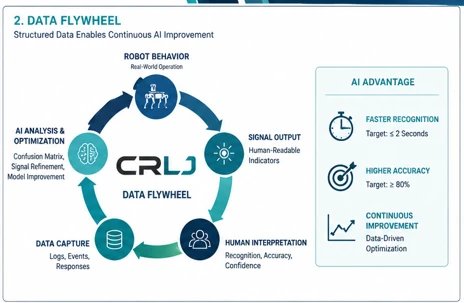
This paper proposes applying The Empathy Layer for Robotics™ to extravehicular operations through decentralized visual telemetry that translates robotic operational states into instantly recognizable human-readable signals. Skollar™ represents the first physical implementation of this framework.
By enabling astronauts to understand robotic behavior through peripheral visual awareness, The Empathy Layer for Robotics™ may reduce cognitive burden, improve situational awareness, increase trust, and enhance operational safety across future exploration missions.
1. The Emerging Role of Robotics in Space Exploration
1.1 The Future of Human-Machine Teaming
Robotics is expected to become a foundational component of future exploration architectures.
Applications include:
- Lunar logistics
- Surface transportation
- Habitat maintenance
- Equipment inspection
- Cargo movement
- Construction support
- Scientific exploration
- Hazard identification
- EVA assistance
Future missions will increasingly involve mixed teams composed of:
- Human astronauts
- Autonomous rovers
- Humanoid systems
- Inspection robots
- Logistics platforms
- AI-enabled support systems
Success will depend not only on robotic capability but on effective coordination between humans and machines.
1.2 The Communication Challenge
Current robotic systems communicate primarily through:
- Diagnostic displays
- Mission software
- Telemetry dashboards
- Network interfaces
- Command systems
While these systems provide detailed information, they are not optimized for rapid human interpretation under operational stress.
Astronauts often operate within:
- Limited fields of view
- Pressurized suits
- Harsh lighting environments
- High cognitive workloads
- Time-critical mission scenarios
Human understanding must become immediate rather than analytical.
2. Cognitive Load as a Mission Risk
2.1 Situational Awareness in Extreme Environments
Situational awareness is widely recognized as a critical contributor to mission success and safety. During EVA operations astronauts must simultaneously monitor:
- Life support systems
- Navigation
- Terrain
- Mission objectives
- Equipment
- Communications
- Team members
Adding autonomous robotic systems increases complexity. But when robotic intent is unclear, astronauts must devote additional cognitive resources toward interpretation. This introduces unnecessary cognitive load.
2.2 The Cost of Ambiguity
A nearby autonomous system may be:
- Idle
- Preparing movement
- Reversing
- Docking
- Recovering from fault conditions
- Awaiting instruction
Without visible communication, astronauts must infer intent through observation. This creates delay, uncertainty, and operational friction. CRLJ defines this challenge as “State Opacity,” which occurs when autonomous systems possess operational information that remains inaccessible to nearby humans.
3. Human-Readable Autonomy
3.1 The Empathy Layer for Robotics™
CRLJ defines The Empathy Layer for Robotics™ as: “A platform-agnostic communication framework that translates robotic behavior, operational state, and intent into instantly understandable human-readable signals.”
The Empathy Layer for Robotics™ does not replace:
- AI systems
- Navigation systems
- Telemetry systems
- Mission-control infrastructure
Instead, it provides a communication bridge between machine intelligence and human understanding.
3.2 Lessons from Aviation and Transportation
We already rely on visual communication layers in many complex systems. Examples include:
- Aircraft navigation lights
- Runway signaling systems
- Vehicle brake lights
- Turn signals
- Emergency lighting
These systems succeed because they:
- Reduce interpretation time
- Increase visibility
- Improve safety
- Require minimal cognitive effort
Future robotics systems may require similar communication frameworks.
4. The Skollar™ Architecture
4.1 Decentralized Edge Processing
CRLJ’s Skollar™ architecture is designed to operate through localized processing rather than cloud-dependent architectures.
Core principles include:
- Low-latency response
- Offline-capable operation
- Deterministic state logic
- Edge-based processing
- Redundant signaling
This approach is designed to keep signaling operational even during:
- Communications disruption
- Relay interruptions
- Network degradation
- Temporary telemetry loss
4.2 Human-Centered Signaling
The system is designed to translate selected machine states into recognizable visual patterns.
Potential operational states include:
- Standby
- Forward movement
- Turning
- Reversing
- Docking
- Low power
- Fault condition
- Emergency state
The objective is ≤ 2-second human interpretation without requiring dashboard consultation.
5. SWaP Optimization
Space missions impose strict Size, Weight, and Power (SWaP) constraints. A space-oriented implementation of Skollar™ would need to minimize operational burden through:
- Lightweight construction
- Efficient processing
- Low power consumption
- Compact integration
Potential material systems include:
- Carbon fiber composites
- Reinforced TPU structures
- Lightweight environmental housings
6. Proposed Research Methodology
6.1 Research Objectives
The proposed research seeks to determine whether visible robotic intent communication improves:
- Recognition speed
- Situational awareness
- Human confidence
- Trust
- Operational efficiency
- Human-machine collaboration
6.2 Experimental Design
Testing environments may include:
- EVA simulations
- Habitat analog environments
- Lunar terrain simulations
- Human-robot coordination exercises
- Mission support scenarios
6.3 Measurement Criteria
Primary measurements include:
Recognition Speed
- Target: ≤ 2 seconds
Interpretation Accuracy
- Target: ≥ 80%
Situational Awareness
- Measured through task performance and observation analysis.
Cognitive Load
- Measured using validated human factors assessment frameworks.
7. Strategic Mission Impact
7.1 Improved Human-Machine Teaming
Human-readable telemetry may improve:
- Team coordination
- Operational trust
- Mission efficiency
- Decision speed
- Task performance
7.2 Communications Redundancy
Localized visual signaling is intended to provide an additional layer of mission resilience. Even during communication degradation, astronauts could maintain visibility of robotic operational state.
7.3 Future Standards Development
As autonomous systems become increasingly integrated with exploration architectures, standardized communication frameworks may become necessary.
Potential future applications include:
- Lunar operations
- Mars missions
- Orbital construction
- Commercial space stations
- Autonomous habitat support
Conclusion
The future of off-Earth exploration depends upon effective collaboration between humans and autonomous systems. To achieve this vision, robotic systems must become understandable as well as intelligent.
The Empathy Layer for Robotics™ introduces a framework for translating machine intent into human-readable communication. Skollar™ is the first physical implementation of this concept.
By reducing cognitive burden, improving situational awareness, and enabling communication at the speed of human instinct, decentralized visual telemetry may become a foundational component of future Human-Machine Teaming architectures.
The next frontier of robotics is not simply autonomy. It is understandable autonomy.